Kubernetes Certified Administrator & Developer KCAD Production Engineering Blueprint Mastery Guide
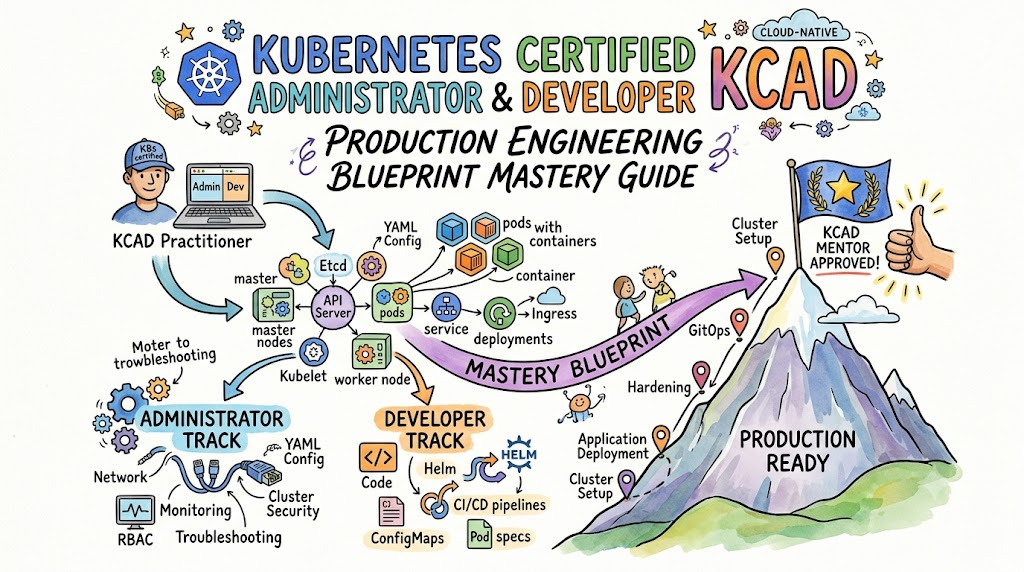
Introduction
High-velocity engineering teams demand professionals who construct fault-tolerant microservices while operating resilient cluster infrastructure. This operational roadmap investigates the Kubernetes Certified Administrator & Developer (KCAD) training delivered through the DevOpsSchool technical education platform. We crafted this practical curriculum for systems administrators, platform builders, cloud architects, and software engineers who direct live container deployments. Therefore, you gain immediate technical clarity across distributed computing environments, transforming routine operational tasks into scalable automation workflows.
Modern software delivery pipelines rely heavily on declarative container orchestration across private and public cloud ecosystems. Consequently, engineers must bridge the traditional gap separating day-to-day application coding from underlying distributed platform mechanics. This deep-dive tutorial demonstrates how to evaluate architectural trade-offs, navigate professional certification levels, and resolve severe cluster outages with absolute confidence. Hence, technical managers and ambitious practitioners build robust capabilities that continuously elevate system availability and team performance.
What is the Kubernetes Certified Administrator & Developer (KCAD)?
The Kubernetes Certified Administrator & Developer (KCAD) establishes a rigorous, hands-on benchmark uniting low-level control plane management with high-performance workload delivery. The qualification emerged because enterprise organizations reject the artificial wall dividing infrastructure maintainers from backend developers. Production emergencies demand that developers troubleshoot misrouted ingress traffic and administrators diagnose failing application pod specifications.
Furthermore, this qualification values real-world terminal competence far above theoretical flashcard memorization. Students engage directly with active multi-node clusters, provisioning self-healing deployments, debugging overlay network routes, and implementing strict resource quotas. Thus, the program confirms an engineer’s readiness to operate effectively inside enterprise-grade continuous deployment ecosystems.
Who Should Pursue Kubernetes Certified Administrator & Developer (KCAD)?
Site reliability practitioners, platform builders, systems administrators, and backend engineers secure enormous career value from this curriculum. Additionally, security analysts enforcing admission controllers and data specialists orchestrating distributed processing frameworks expand their technical capabilities significantly. The syllabus guides developers stepping away from monolithic applications as well as senior leads who want to enforce unified operating practices.
Moreover, engineering directors extract substantial strategic value from these concepts, enabling them to forecast infrastructure spend accurately and maintain aggressive availability targets. In dynamic technology hubs throughout India alongside global engineering centers in Europe and the United States, enterprises actively seek versatile practitioners. Therefore, this curriculum helps modern engineers align localized technical skills with international enterprise architectural standards.
Why Kubernetes Certified Administrator & Developer (KCAD) is Valuable and Beyond
Enterprise technology platforms consistently increase their adoption of containerized microservices across hybrid and multi-cloud footprints, driving immense demand for certified talent. While individual deployment tools continuously evolve, foundational principles like control loops, state reconciliation engines, and overlay networks remain unchanged. Thus, this learning path instills timeless systems logic that outlasts ephemeral tooling updates.
Additionally, mastering both platform administration and cloud-native software construction eliminates destructive communication handoffs between engineering teams. You diagnose container restarts, volume mount failures, and broken routes independently without waiting for external ticket resolutions. Consequently, your career return on investment surfaces as greater engineering autonomy, elevated business impact, and rapid promotion toward technical leadership.
Kubernetes Certified Administrator & Developer (KCAD) Certification Overview
The training program runs entirely through the official instructional syllabus provided on the DevOpsSchool technical portal, delivering a hands-on assessment structure designed for working professionals. Rather than relying on simple multiple-choice formats, it evaluates real engineering skills inside simulated terminal environments. Candidates configure actual worker nodes, repair broken system pods, and secure live clusters against operational timeouts.
Furthermore, the syllabus enforces measurable competency checkpoints across platform internals, software delivery pipelines, distributed storage, and networking layers. Independent enterprise review panels constantly audit every module to reflect actual industry engineering patterns. Earning this dual-purpose credential demonstrates that you can confidently stabilize production systems during high-stakes outages.
Why Choose DevOpsSchool
DevOpsSchool supplies enterprise-focused technical training guided by veteran practitioners who architect distributed environments on a daily basis. Instead of presenting generic academic slides, the institute provides dedicated interactive lab environments, authentic production use cases, and round-the-clock implementation support. Moreover, instructors frequently update course modules to match changing open-source conventions and current infrastructure trends.
In addition to interactive lectures, participants receive permanent access to peer forums, simulated terminal challenges, and complete architecture walkthroughs. This immersive environment bridges theoretical systems knowledge and live operational execution. As a result, working engineers and technical organizations depend on these comprehensive programs to accelerate complex digital transformation initiatives.
Kubernetes Certified Administrator & Developer (KCAD) Certification Tracks & Levels
The educational path follows three distinct development tiers: Foundation, Professional, and Advanced. The Foundation level targets declarative workload concepts, standard pod design, resource namespaces, and command-line execution. Therefore, early-career engineers build baseline fluency without suffering cognitive overload from control plane internals.
The Professional level moves directly into multi-node operational engineering, software-defined networks, dynamic volume allocation, and automated rollout patterns. Learners complete production tasks, including configuring zero-downtime canary updates and establishing granular role-based access rules. Consequently, graduates at this stage take full ownership of mission-critical production fleets.
The Advanced level addresses multi-cluster topologies, custom resource controllers, admission webhooks, and Linux kernel optimization under intensive network stress. It also leads directly into specialized disciplines such as SRE, DevSecOps, and FinOps. Hence, principal engineers readily align their technical expertise with high-level architectural goals.
Complete Kubernetes Certified Administrator & Developer (KCAD) Certification Table
| Track | Level | Who it’s for | Prerequisites | Skills Covered | Recommended Order |
|---|---|---|---|---|---|
| Core Cloud-Native | Foundation | Junior Engineers, System Admins | Basic Linux, Containers | Pod lifecycle, basic networking, CLI usage | Step 1 |
| Cluster Administration | Professional | SREs, Platform Engineers | Core Foundation, Networking | Etcd backups, CNI, kubeadm, RBAC | Step 2 |
| Workload Development | Professional | Backend Developers, DevOps | Foundation, YAML syntax | Deployments, Services, ConfigMaps, PV/PVC | Step 3 |
| Production Operations | Advanced | Principal SREs, Cloud Architects | Admin & Dev tracks | Multi-cluster networking, CRDs, Service Mesh | Step 4 |
| Cluster Governance | Advanced | Security Leads, DevSecOps | Professional Admin | Network policies, admission webhooks, audit logs | Step 5 |
Detailed Guide for Each Kubernetes Certified Administrator & Developer (KCAD) Certification
Kubernetes Certified Administrator & Developer (KCAD) – Foundation Level
What it is
This initial stage validates a practitioner’s command over fundamental container mechanics, declarative resources, and day-to-day command-line interactions. The exam confirms that you inspect container runtimes, parse pod events, and execute standard namespace operations safely.
Who should take it
Aspiring cloud engineers, operations support personnel, and software developers transitioning into modern containerized environments will extract tremendous benefit from this program. It creates a structured starting point for hands-on systems operations.
Skills you’ll gain
- Investigating pod states using core command-line switches.
- Defining declarative manifests for stateless microservices.
- Setting CPU and memory limits to prevent cluster overcommit.
- Isolating development and staging resources across namespaces.
Real-world projects you should be able to do
- Deploy a multi-tier stateless web service across dedicated namespaces.
- Resolve application container start crashes by analyzing standard output logs.
- Mount application configuration maps and secrets directly into container runtimes.
Preparation plan
- 7–14 Days: Master standard terminal commands, resource labeling, and imperative manifest generation.
- 30 Days: Complete twenty hands-on lab exercises and compose declarative configurations from memory.
- 60 Days: Assemble microservice pipelines from bare configuration files while reviewing Linux administration basics.
Common mistakes
- Relying heavily on quick imperative commands rather than crafting reusable declarative files.
- Forgetting compute resource requests, leading to unstable pod scheduling.
- Setting mismatched port numbers between container endpoints and service definitions.
Best next certification after this
- Same-track option: Administrator Professional Level
- Cross-track option: Cloud Infrastructure Fundamentals
- Leadership option: Certified Systems Operations Lead
Kubernetes Certified Administrator & Developer (KCAD) – Professional Level
What it is
This credential validates an engineer’s capability to provision, configure, and maintain high-availability clusters and stateful microservice architectures. The curriculum confirms that you initialize control planes using kubeadm and troubleshoot complex distributed network failures.
Who should take it
Practicing platform engineers, systems administrators, and DevOps specialists who maintain uptime across distributed business applications should target this credential.
Skills you’ll gain
- Provisioning multi-node control planes with secure cryptographic certificates.
- Configuring dynamic volume provisioners using diverse enterprise storage layers.
- Implementing reverse proxy ingress controllers with custom domain routing.
- Executing consistent control plane snapshots and full etcd recoveries.
Real-world projects you should be able to do
- Restore a completely non-responsive control plane after TLS certificate expirations.
- Provision a replicated stateful database using persistent volume controllers.
- Configure strict role-based access controls to safeguard multi-tenant clusters.
Preparation plan
- 7–14 Days: Solve hands-on control plane failure scenarios daily to sharpen diagnostic speed.
- 30 Days: Provision and destroy ten multi-node environments while practicing etcd restoration.
- 60 Days: Migrate legacy monolithic architectures into declarative, automated rollout pipelines.
Common mistakes
- Ignoring control plane systemd logs when diagnosing unreachable nodes.
- Defining incorrect node affinity labels, stranding critical workloads.
- Misconfiguring storage provisioner access modes, triggering persistent volume timeouts.
Best next certification after this
- Same-track option: Advanced Operations and Mesh Architect
- Cross-track option: Certified Cloud Security Practitioner
- Leadership option: Platform Engineering Manager Track
Kubernetes Certified Administrator & Developer (KCAD) – Advanced Level
What it is
This elite tier verifies principal engineers who design resilient, enterprise-wide platform architectures across complex hybrid-cloud estates. It evaluates your ability to author custom operators, build admission controllers, and optimize low-level operating system performance.
Who should take it
Chief architects, principal platform developers, and senior infrastructure leads who design multi-region container ecosystems should complete this level.
Skills you’ll gain
- Developing custom controllers to automate complex platform operations.
- Tuning Linux kernel parameters directly through node configurations to handle heavy input-output traffic.
- Automating advanced canary releases based on live platform metrics.
- Enforcing mutual TLS encryption and traffic filtering across microservice meshes.
Real-world projects you should be able to do
- Construct a bespoke Go-based operator that automates distributed application deployments.
- Direct multi-cluster network traffic across hybrid cloud regions.
- Eliminate severe kernel-level connection tracking bottlenecks under extreme concurrency.
Preparation plan
- 7–14 Days: Master reconciliation loops using standard operator development software packages.
- 30 Days: Build mutating and validating admission webhooks to enforce configuration compliance.
- 60 Days: Architect an automated multi-tenant platform featuring strict network isolation.
Common mistakes
- Neglecting the memory footprint that custom resources impose on etcd.
- Writing poorly tested admission webhooks that deadlock the entire API server.
- Overlooking epoll limits on heavily saturated worker nodes.
Best next certification after this
- Same-track option: Cloud-Native Enterprise Architect
- Cross-track option: DevSecOps Specialist
- Leadership option: Chief Technology Officer Certification
Choose Your Learning Path
DevOps Path
This learning path weaves declarative manifest creation into rapid continuous integration and continuous deployment pipelines. Engineers manage configuration files inside version control repositories, triggering automated unit and integration tests upon every code commit. In addition, you build automated rollback strategies that protect production environments from broken container images. Consequently, software teams ship updates with exceptional velocity and minimal deployment friction.
DevSecOps Path
This trajectory embeds security checks into every phase of the platform lifecycle. You deploy admission webhooks that block insecure images, scan base layers for known vulnerabilities, and enforce unprivileged user contexts across pods. Furthermore, engineers build fine-grained network policies to block lateral attack traffic between namespaces. As a result, security functions as an integrated automated shield instead of an eleventh-hour roadblock.
SRE Path
The reliability pathway balances rapid code releases with stringent uptime metrics and service level objectives. Engineers establish intelligent health checks, configure dynamic horizontal pod autoscalers, and implement automated node-draining routines. Additionally, you construct self-healing configurations that isolate crashing pods and shed non-essential traffic during network spikes. Therefore, mission-critical applications maintain high availability under unpredictable user demand.
AIOps Path
This specialty applies machine learning algorithms to platform metrics, system traces, and operating system logs. Engineers filter out meaningless event noise, identify emerging failure patterns, and trigger proactive capacity expansions before outages occur. Furthermore, you connect intelligent monitoring engines to automated remediations that repair recurring container failures. Consequently, operations teams slash their mean time to resolution across enterprise deployments.
MLOps Path
The MLOps pathway orchestrates distributed model training and real-time model inference workloads inside dynamic container fleets. You manage shared GPU clusters, coordinate batch pipeline executions, and deploy custom inference engines. Moreover, engineers configure high-performance shared storage volumes to feed machine learning pipelines without generating input-output bottlenecks. This discipline turns experimental data science models into resilient, scalable web services.
DataOps Path
The data operations path runs high-throughput analytical engines and real-time streaming services within resilient container environments. You configure distributed data stores, schedule multi-stage pipeline workloads, and maintain data storage across unexpected node terminations. In addition, engineers build automated data recovery routines that prevent data loss during underlying compute maintenance. Thus, business intelligence teams rely on highly stable data pipelines.
FinOps Path
The cloud financial management track optimizes computing expenses across enterprise container deployments. Engineers dissect cluster utilization records, establish strict resource quotas, and eliminate zombie workloads that waste compute budget. Furthermore, you architect hybrid node pools featuring spot instances to cut cloud infrastructure bills dramatically without compromising application uptime. Hence, platform architects deliver maximum engineering performance while controlling operational costs.
Role → Recommended Kubernetes Certified Administrator & Developer (KCAD) Certifications
| Role | Recommended Certifications |
|---|---|
| DevOps Engineer | KCAD Professional Level, Continuous Delivery Architect |
| SRE | KCAD Professional Level, Site Reliability Practitioner |
| Platform Engineer | KCAD Advanced Level, Cloud-Native Operator Specialist |
| Cloud Engineer | KCAD Professional Level, Infrastructure Orchestrator |
| Security Engineer | KCAD Foundation Level, DevSecOps Compliance Lead |
| Data Engineer | KCAD Foundation Level, Distributed Data Architect |
| FinOps Practitioner | KCAD Foundation Level, Cloud Economics Practitioner |
| Engineering Manager | KCAD Foundation Level, Technical Platform Director |
Next Certifications to Take After Kubernetes Certified Administrator & Developer (KCAD)
Same Track Progression
Deepening your systems mastery requires pursuing elite credentials centered on distributed architecture and kernel performance engineering. Dedicated engineers target advanced service mesh implementations, multi-cluster federation models, and low-level Linux networking controls. Furthermore, mastering custom resource controllers and core API extensions establishes your standing as an expert platform builder. This deep technical competence positions you to design enterprise-wide platform migrations.
Cross-Track Expansion
Broadening your technical horizons across complementary fields prevents specialized stagnation and enriches your architectural perspective. You should pursue specialized training in automated compliance frameworks, zero-trust cloud security, or distributed streaming platforms. Furthermore, combining container administration with enterprise event-driven architecture expands your ability to solve multi-faceted organizational challenges. Consequently, you emerge as a versatile systems engineer capable of leading multidisciplinary teams.
Leadership & Management Track
Progressing from hands-on terminal operations into engineering management requires aligning technical investments with direct enterprise value. Advanced certifications covering enterprise architecture governance, technology leadership, and product management provide essential skills. You translate complex system reliability metrics into clear business value, lead engineering teams, and oversee significant infrastructure budgets. Thus, senior platform specialists transition smoothly into Director of Engineering and Chief Technology Officer roles.
Training & Certification Support Providers for Kubernetes Certified Administrator & Developer (KCAD)
The Core Platform Authority
DevOpsSchool provides industry-recognized technical training programs that help platform engineers master modern infrastructure operations. The organization provides hands-on laboratory environments that reproduce the challenges of real enterprise systems. Students gain permanent access to updated technical documentation, architecture blueprints, and ongoing mentorship from veteran engineers who manage large-scale systems. The curriculum prioritizes actual command-line troubleshooting and root-cause analysis over simple theoretical memorization, instilling the practical confidence needed to handle complex production workloads. Consequently, organizations and engineers worldwide turn to these programs to execute container adoptions and cluster migrations safely.
DevOpsSchool delivers hands-on cloud-native certifications featuring real enterprise workflows, live troubleshooting environments, and continuous mentorship from industry engineers with decades of production experience.
Cotocus delivers focused enterprise technical consulting and engineering enablement programs designed to help technical teams adopt automated container deployment practices smoothly and securely.
Scmgalaxy provides comprehensive open-source documentation, detailed technical tutorials, community forums, and reference architectures that support engineers pursuing rigorous platform engineering credentials.
BestDevOps curates independent educational reviews, comparative course breakdowns, and career development guides for engineers evaluating technical certifications in modern systems administration.
DevSecOpsSchool specializes exclusively in integrating security testing, automated compliance verification, and shift-left defensive controls directly into declarative cloud-native pipelines.
SRESchool focuses deeply on platform resilience engineering, service level objective management, and distributed systems incident response across scaled container fleets.
AIOpsSchool teaches automated operational triage, predictive incident resolution, and artificial intelligence integration for complex, modern enterprise infrastructure environments.
DataOpsSchool concentrates on building automated, high-volume data streaming pipelines and managing stateful, analytical workloads within scalable container platforms.
FinOpsSchool delivers structured education on cloud financial operations, infrastructure cost reduction strategies, and transparent resource accounting across enterprise platforms.
Frequently Asked Questions (General)
1. What difficulty level defines this technical evaluation?
Candidates tackle a challenging, fully practical assessment delivered exclusively inside live command-line terminal environments. You must configure active workloads, resolve control plane outages, and compose accurate manifests under tight time constraints.
2. How much study time should a working engineer schedule?
Engineers possessing sound Linux system administration experience typically require six to eight weeks of focused daily preparation. Candidates without prior container background should commit to twelve weeks of consistent hands-on lab practice.
3. Do students need specific mandatory prerequisites before beginning?
The program establishes no formal credentials as prerequisites for enrollment. Nonetheless, holding working experience with Linux command-line tools, basic shell scripting, and basic network protocols proves immensely beneficial.
4. How does this credential provide a measurable career return?
The curriculum validates real engineering ability, eliminating the skepticism associated with multiple-choice tests. Consequently, certified engineers gain greater professional autonomy, land high-impact platform assignments, and unlock senior career opportunities.
5. What sequence should engineers follow across the certification levels?
Candidates should first master foundational declarative workload configurations and core command-line tools. Next, progress into multi-node administrative tasks, networking setups, and control plane debugging before advancing into specialized operational pathways.
6. Does this course cover bare-metal servers alongside public cloud providers?
Core open-source patterns operate consistently across bare-metal machines, virtual environments, and major public cloud providers. You master upstream binaries, standard network interfaces, and portable manifest structures that function identically everywhere.
7. How hands-on are the actual learning modules?
The entire training framework focuses on interactive command-line environments. Every session forces you to execute live commands, repair synthetic system crashes, and configure distributed services within realistic production contexts.
8. Will these skills transfer smoothly to managed cloud container services?
Major cloud vendors run the same open-source APIs, admission controllers, and declarative specs as upstream distributions. Therefore, the diagnostic methods and architectural techniques you master transfer directly into managed enterprise cloud products.
9. What workstation hardware do I need to prepare?
Any modern computer capable of running a web browser and establishing terminal connections handles the remote lab environments. Engineers creating local virtual clusters need a modern multi-core CPU and at least sixteen gigabytes of system memory.
10. How often do open-source updates alter the examination curriculum?
The instructional syllabus incorporates upstream platform updates several times a year. Minor command variations happen periodically, but core architecture patterns like control loop reconciliation remain dependable over extended timelines.
11. Do application developers extract real value from this infrastructure track?
Developers discover how container engines balance workloads, handle network communication, and terminate pods under memory pressure. These insights help them build more resilient software and eliminate elusive deployment bugs.
12. How does this qualification compare to traditional multiple-choice certifications?
Traditional evaluations rely on passive memorization of definitions and superficial concepts. Conversely, this practical qualification demands rapid problem-solving, precise syntax, and real-time execution inside active terminal environments.
FAQs on Kubernetes Certified Administrator & Developer (KCAD)
1. Does the combined KCAD path differ from standalone administration tracks?
The unified program links system administration with software deployment, removing the operational divide separating cluster provisioning from application runtime management. Rather than evaluating cluster maintenance in isolation, you study both disciplines simultaneously. Therefore, you see how scheduling configurations, resource allocations, and network rules dictate application availability during node interruptions.
2. What precise networking concepts appear throughout the curriculum?
The syllabus covers Container Network Interface plugins, cross-node packet routing, kube-proxy routing rules, and internal domain name resolution. Engineers deploy ingress controllers, expose applications through service abstractions, and enforce network policies. Furthermore, you will diagnose broken service selectors and fix asymmetric routing bugs in multi-tier applications.
3. Should candidates learn Go programming before enrolling in this track?
This certification does not require candidates to write production Go code. You simply need a firm grasp of container runtimes, image packaging, and structured YAML syntax for declarative resources. Basic shell scripting helps automate routine terminal actions, but general application programming remains outside the testing scope.
4. How does the coursework prepare engineers for live production incidents?
The coursework immerses students in broken clusters, misconfigured control planes, and failing pods, teaching structured root-cause analysis under time pressure. Rather than guessing randomly, you systematically examine node conditions, review systemd logs, and trace raw events. This discipline ensures you quickly resolve missing secrets, policy conflicts, and process failures.
5. Which exact disaster recovery procedures will I practice?
You generate live snapshots of the distributed etcd datastore and restore state data onto clean replacement nodes. Additionally, you confirm data consistency, verify component recovery, and replace failed worker nodes safely. These practical exercises prepare engineers to survive serious hardware drops and database corruptions without losing data.
6. In what manner does the training enforce enterprise security standards?
Security principles run through every chapter, including role-based permissions, service accounts, and runtime security contexts. You learn to forbid root container execution, configure read-only filesystems, and apply restrictive network policies. Furthermore, the course guides you in configuring mutual TLS authentication to protect sensitive internal services.
7. Does this curriculum address stateful workloads and persistent storage?
The material thoroughly explores persistent volumes, persistent volume claims, storage classes, and dynamic volume provisioning. You configure stateful controllers, observe predictable network identifiers, and manage persistent storage attachments across node failures. Consequently, you will confidently run distributed databases, queues, and persistent services on top of dynamic container infrastructure.
8. Why do instructors prioritize declarative configurations over imperative commands?
Imperative commands provide quick fixes during local development, but they fail to scale across collaborative enterprise teams. Declarative manifests let you store infrastructure states in version control, execute code reviews, and automate deployment workflows. By adopting declarative practices, your organization establishes reproducible, self-healing environments that recover smoothly from infrastructure failures.
Final Thoughts: Is Kubernetes Certified Administrator & Developer (KCAD) Worth It?
Stepping into this rigorous technical journey demands focused dedication and clear career goals. The technology market frequently promotes superficial credentials that fail to prepare engineers for actual production challenges. In contrast, examinations that evaluate your real-time troubleshooting skills inside live terminal environments offer lasting professional credibility.
When you can inspect a degraded cluster, rapidly identify failing control loops, and restore network traffic, you deliver immense engineering value to your company. The true worth of this credential lies in the operational instincts and disciplined troubleshooting techniques you forge throughout the journey. Engineers who seek genuine technical authority across modern distributed platforms will find this comprehensive program exceptionally rewarding.
Leave a Reply