Mastering Enterprise DevSecOps Automation And Scalable Cloud Workload Security Architecture Systems
Introduction
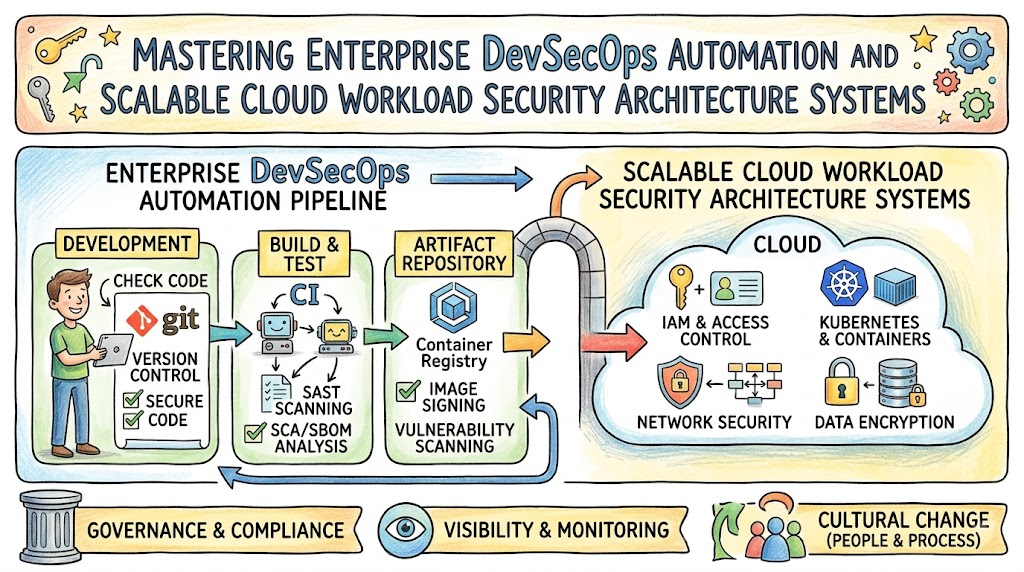
Accelerating digital delivery requires engineering teams to rethink how they build, verify, and deploy software. When teams postpone security validations until the final pre-production stage, they trigger expensive release delays, discover critical flaws under pressure, and introduce friction between developers and operations. Therefore, forward-thinking organizations embed automated security controls directly into continuous integration workflows to detect vulnerabilities instantly.
Modern engineering leaders now prioritize proactive automation over reactive compliance checkpoints. Consequently, developers receive real-time vulnerability feedback inside their daily pull request workflows, allowing them to remediate code defects without leaving their local environments. This comprehensive blueprint explores proven architectures, operational methodologies, and practical frameworks to secure enterprise pipelines, container platforms, and cloud workloads.
The Strategic Value Of Shifting Security Left
Engineering velocity often collides with security governance when organizations rely on manual audit gates before production deployments. Ephemeral cloud instances and high-frequency code commits quickly overwhelm traditional security reviews. Industry research confirms that resolving a vulnerability in production requires up to thirty times more resources than fixing that exact flaw during active development.
Legacy Delivery:   [ Build ] ──> [ Package ] ──> [ Release Gate ] ──x (Bottleneck & Rework)
DevSecOps Pipeline: [ Commit + SAST ] ──> [ Build + SCA ] ──> [ Test + DAST ] ──> [ Automated Deploy ]
Shifting security left enables teams to inspect code at commit time, catching insecure patterns immediately. Consequently, automated guardrails eliminate release blockers, optimize engineering spend, and safeguard production clusters from external compromises. The table below demonstrates how modern security practices outperform traditional methodologies:
| Evaluation Criteria | Legacy Security Practices | Modern DevSecOps Architecture |
|---|---|---|
| Inspection Phase | Final pre-release stage | Continuous across commit, build, and runtime |
| Feedback Speed | Weeks or months after development | Instant notifications in IDEs and pull requests |
| Accountability | Isolated security audit teams | Shared ownership across engineering squads |
| Resolution Cost | High due to architectural refactoring | Minimal because developers fix source flaws immediately |
| Release Cadence | Unpredictable and slow | Fast, reliable, and automated |
Architectural Pillars Of Continuous Threat Protection
Constructing an enterprise defense ecosystem demands a synchronized alignment of automated tooling, clear organizational policies, and active developer participation. First, engineering teams must establish automated pipeline triggers that inspect code repositories, validate dependencies, and enforce cryptographic signing. In addition, platform teams must deploy policy-as-code engines to maintain uniform governance across distributed infrastructure.
Furthermore, centralized telemetry dashboards provide real-time visibility into enterprise vulnerability trends and remediation velocity. High-performing security architectures rely on three foundational pillars:
- Automated Pipeline Guardrails: Pre-commit hooks and build scripts that immediately intercept hardcoded secrets, insecure libraries, and configuration errors.
- Unified Observability Consoles: Aggregated monitoring platforms that correlate runtime alerts, pipeline telemetry, and compliance status.
- Contextual Remediation Guidance: Direct developer notifications containing clear code snippets, documentation references, and upgrade paths.
Cloud Infrastructure And Multi-Cloud Security Hardening
Cloud environments offer unparalleled scalability, but misconfigured permissions, open storage endpoints, and overly permissive IAM policies expose businesses to severe risk. Therefore, enterprise organizations partner with specialized advisors for Cloud Security Consulting Services to harden multi-cloud deployments across leading providers. Security teams analyze infrastructure-as-code manifests, identity boundaries, and network topologies before provisioning resources into live environments.
[ IaC Template ] ──> [ Static Policy Scan ] ──> [ Terraform Apply ] ──> [ Cloud Workload Monitoring ]
Moreover, policy-as-code engines evaluate configuration changes automatically against strict regulatory baselines before deployment. Whenever an engineer submits an insecure storage configuration, automated linters reject the pull request with specific guidance. Consequently, engineering organizations scale their cloud footprint safely without creating shadow infrastructure.
Kubernetes Container Defense And Cluster Governance
Container orchestration platforms introduce sophisticated networking, workload scheduling, and runtime isolation challenges that demand specialized defensive strategies. Organizations frequently utilize Kubernetes Security Consulting Services to configure granular role-based access control, enforce pod security standards, and deploy admission controllers. Security engineers monitor inter-pod traffic using declarative network policies to contain potential container breakouts.
Similarly, platform teams enforce image signature verification within container registries to block untrusted artifacts from running in clusters. Automated vulnerability scanners continuously inspect base images and third-party binaries throughout their runtime lifecycle. As a result, operations teams maintain robust isolation and deep visibility across their container infrastructure.
Securing The Software Supply Chain And Artifact Integrity
Modern enterprise applications rely heavily on open-source libraries, container base layers, and third-party frameworks. Threat actors continuously target upstream repositories, package managers, and automated continuous integration pipelines to distribute malicious code. Consequently, security leaders deploy Software Supply Chain Security Services to generate software bills of materials (SBOMs), audit open-source components, and enforce cryptographic artifact signing.
[ Ingest Library ] ──> [ SCA & License Audit ] ──> [ Generate SBOM ] ──> [ Cosign Artifact ] ──> [ Deploy ]
Additionally, automated dependency monitors cross-examine third-party modules against global vulnerability catalogs around the clock. Whenever a security team discovers a vulnerable dependency, automated systems generate pull requests containing tested version updates. Therefore, organizations dramatically reduce their attack surface while maintaining complete visibility over every software component.
End-To-End Security Testing Across Delivery Pipelines
A resilient defense posture integrates multiple testing disciplines across the entire software delivery lifecycle instead of relying on a single scanning engine. During early code authoring, Static Application Security Testing (SAST) evaluates source logic for injection vulnerabilities and structural weaknesses. Meanwhile, Software Composition Analysis (SCA) tracks external libraries, and secret detection tools prevent credential leaks.
Phase 1: Code & Commit    ──> SAST, Secret Scanning, and Linting
Phase 2: Build & Package  ──> SCA, License Auditing, and Container Base Scans
Phase 3: Test & Stage     ──> DAST, API Fuzzing, and Policy Validation
Phase 4: Pre-Release      ──> Penetration Testing Services and Threat Audits
Subsequently, Dynamic Application Security Testing (DAST) inspects running applications in staging environments to evaluate live authentication workflows and business logic. To evaluate defense resilience against sophisticated adversaries, organizations regularly schedule rigorous Penetration Testing Services across applications, APIs, and cloud networks. Consequently, this multi-layered inspection strategy uncovers critical weaknesses before unauthorized actors can exploit them.
Evaluating Maturity With DevSecOps Assessment Services
Before adopting complex tooling stacks, engineering leaders must evaluate their current security posture, delivery bottlenecks, and pipeline visibility. Engaging expert DevSecOps Assessment Services allows leadership to benchmark existing development workflows against recognized maturity frameworks. Security auditors evaluate code review standards, release cadences, infrastructure configurations, and organizational collaboration.
Following the evaluation, organizations receive an actionable transformation roadmap that prioritizes critical vulnerabilities and highlights immediate operational improvements. This structured assessment eliminates wasteful tool procurement and aligns engineering initiatives with business risk management. As a result, technical leaders execute targeted modernization initiatives with measurable success.
Strategic Guidance Through DevSecOps Consulting Services
Navigating an enterprise security transformation requires strategic leadership, mature architectural design, and clear organizational alignment. Through comprehensive DevSecOps Consulting Services, enterprises access specialized governance models, compliance automation blueprints, and scalable threat modeling frameworks. Dedicated consultants collaborate directly with engineering executives to design security strategies that match organizational delivery velocities.
[ Discovery & Architecture ] ──> [ Policy Design ] ──> [ Toolchain Integration ] ──> [ Operational Scale ]
Furthermore, consultants provide custom implementation plans for secrets management, automated compliance reporting, and pipeline observability. Expert advisors help engineering organizations overcome cultural resistance and accelerate adoption across multiple departments. Consequently, enterprises elevate their security posture while preserving high developer velocity and software quality.
Pipeline Automation Via DevSecOps Implementation Services
Designing a theoretical architecture represents only half the challenge, while embedding automated tooling into active pipelines requires precise technical execution. Through specialized DevSecOps Implementation Services, automation engineers install static analyzers, secret detectors, container scanners, and policy engines directly into continuous integration workflows. Technical specialists configure pull request comments, non-blocking alert rules, and centralized vulnerability consoles tailored to team workflows.
In addition, implementation specialists automate environment provisioning through hardened infrastructure templates and admission controllers. Engineers route contextual vulnerability alerts directly into developer issue trackers for rapid resolution. As a result, engineering squads immediately benefit from automated security checks without experiencing pipeline instability.
Continuous Operations With DevSecOps Managed Services
Maintaining pipeline security tooling, refining alert thresholds, and remediating emerging vulnerabilities requires ongoing operational expertise that internal teams often lack. Leveraging DevSecOps Managed Services provides enterprises with dedicated security operations specialists who monitor scanning infrastructure, eliminate false positives, and fine-tune detection engines continuously. These specialists support internal development teams by providing immediate remediation guidance and investigating complex alerts.
[ Continuous Monitoring ] ──> [ Alert Triage & Filtering ] ──> [ Developer Guidance ] ──> [ Policy Tuning ]
Moreover, managed service teams perform recurring health audits across cloud environments, container registries, and continuous integration engines. This continuous operational support ensures that pipeline policies evolve alongside newly discovered vulnerabilities and regulatory requirements. Consequently, internal software engineers focus on developing core business functionality while maintaining comprehensive security coverage.
Upskilling Engineers With Practical DevSecOps Training
Automated tooling succeeds only when individual developers and platform engineers understand secure coding principles and pipeline defense concepts. Interactive DevSecOps Training provides software engineers, operations specialists, and architects with hands-on experience in threat modeling, container hardening, and automated pipeline security. Participants configure real-world static analysis rules, remediate code vulnerabilities, and enforce container runtime protections.
These practical training courses emphasize laboratory exercises where engineers analyze and neutralize simulated pipeline attacks. As a result, technical professionals gain the operational confidence required to build secure architectures and advocate for defensive best practices within their project squads.
Scaling Enterprise Teams Through Corporate DevSecOps Training
Large enterprises with distributed development teams require standardized security practices, unified tooling vocabularies, and consistent operational frameworks. Tailored Corporate DevSecOps Training programs upskill cross-functional groups of software developers, DevOps practitioners, quality assurance engineers, and cloud architects simultaneously. Experienced trainers customize course modules to align with the enterprise’s unique tech stack, compliance mandates, and internal delivery pipelines.
[ Cross-Functional Alignment ] ──> [ Custom Stack Labs ] ──> [ Shared Ownership ] ──> [ Scalable Governance ]
Training entire departments concurrently breaks down organizational silos and fosters a culture of shared security ownership. Furthermore, standardized corporate education streamlines onboarding for new engineers, minimizes architectural defects, and maintains uniform security across all business units.
Critical Anti-Patterns To Avoid In Pipeline Defense
Organizations often introduce operational friction during security transformations by implementing flawed rollout strategies. Recognizing common organizational pitfalls helps engineering leaders execute smoother transitions and maintain developer trust:
- Enforcing Strict Build Breakers Immediately: Failing builds on low-severity issues creates developer frustration and encourages workarounds.
- Accumulating Disconnected Tools: Purchasing multiple siloed scanners without central reporting creates alert fatigue and operational confusion.
- Ignoring Developer Experience: Mandating complex security tasks without providing clear remediation documentation slows down release velocity.
- Treating Security As A Single Checkpoint: Auditing code only during final deployment gates recreates legacy release bottlenecks.
Engineering A Resilient Developer-First Security Culture
Building lasting security resilience depends heavily on fostering collaborative relationships between developers, operations teams, and security specialists. Leadership must establish blameless incident reviews that encourage transparent discussion whenever vulnerabilities or operational defects arise. Furthermore, rewarding engineering teams that resolve technical debt proactively builds trust and long-term engagement.
[ Core Security Team ] ──> [ Security Champions ] ──> [ Feature Engineering Squads ]
Establishing a dedicated Security Champions network places trained security advocates directly inside individual feature teams. These champions assist their peers with secure code design, conduct initial threat reviews, and streamline communication with the central security group. Consequently, security transforms from an external barrier into a core engineering discipline.
DevSecOpsNow Platform Overview And Core Capabilities
DevSecOpsnow delivers practical, vendor-neutral educational guides, reference architectures, and tactical implementation frameworks for modern software teams. Whether an engineering department requires strategic roadmap planning, container security blueprints, or practical pipeline automation advice, the platform provides accessible knowledge for practitioners. Development teams utilize these comprehensive resources to modernize their release pipelines safely.
Moreover, the platform emphasizes production-tested methodologies proven across enterprise cloud migrations, container orchestrations, and high-frequency delivery workflows. By breaking down complex defensive strategies into simple, actionable steps, engineering teams accelerate their operational maturity and protect valuable intellectual property.
Phased Implementation Blueprint For Modern Enterprises
Transforming enterprise security requires a phased, progressive adoption model that delivers immediate improvements without disrupting release schedules. Following a structured roadmap ensures steady progress toward operational maturity:
Phase 1: Assess Current Gaps    ──> Audit repositories, map pipelines, and define baseline metrics.
Phase 2: Pipeline Foundations   ──> Deploy secret detection, SAST, and automated SCA scanning.
Phase 3: Platform Hardening     ──> Enforce Policy as Code, container scanning, and cloud IAM limits.
Phase 4: Continuous Verification ──> Implement DAST, penetration testing, and ongoing team training.
- Step 1 — Discovery and Pipeline Mapping: Audit all source repositories, catalog external dependencies, and identify visibility gaps across current delivery workflows.
- Step 2 — Initial Pipeline Protections: Deploy pre-commit hooks, secret scanners, and dependency analyzers in non-blocking notification mode.
- Step 3 — Infrastructure and Container Hardening: Integrate infrastructure-as-code linters, container image signing, and automated cloud compliance checks.
- Step 4 — Runtime Defense and Skill Development: Introduce dynamic testing in staging, conduct comprehensive penetration testing, and deliver hands-on training to engineering teams.
Frequently Asked Questions About DevSecOpsNow
- Which major organizational challenges does DevSecOps solve for enterprise teams?DevSecOps removes pre-release testing bottlenecks, lowers vulnerability remediation costs, and embeds automated security validations directly into daily continuous integration workflows.
- How do static and dynamic application security testing methodologies differ?Static testing inspects source code for structural flaws without executing the program, while dynamic testing evaluates running staging applications to detect functional and operational vulnerabilities.
- Why do modern development teams prioritize software bill of materials generation?Software bills of materials provide a complete inventory of application components and dependencies, enabling rapid vulnerability tracking and patching whenever security advisories appear.
- What responsibilities do security champions handle within agile squads?Security champions serve as embedded security advocates within development teams, guiding peers through threat modeling, resolving vulnerabilities, and facilitating communication with central security departments.
- How does policy as code strengthen enterprise cloud security?Policy as code defines and enforces infrastructure compliance rules programmatically, preventing misconfigured cloud resources and unauthorized network exposures prior to deployment.
- When should engineering leadership request an external security assessment?Leaders should request professional assessments during cloud migrations, major architectural redesigns, compliance audit preparations, or when identifying visibility gaps across delivery pipelines.
- How do managed security services assist engineering teams with limited resources?Managed security services provide dedicated engineers who monitor pipelines, triage alerts, eliminate false positives, and provide actionable remediation guidance to internal developers.
- Why does corporate team training deliver superior results compared to individual learning?Corporate training unites cross-functional teams around standardized tools, internal architectures, and shared best practices, eliminating departmental silos and accelerating organizational adoption.
- How do automated secret scanners protect cloud infrastructure from exposure?Secret scanners inspect code commits, configuration files, and pull requests using pattern matching to identify and block hardcoded credentials before they reach central repositories.
- What is the most effective method to introduce security gates without disrupting engineering velocity?Teams should deploy security scanners in non-blocking audit mode to calibrate accuracy, gradually introducing automated build failures only for verified, high-risk security flaws.
Final Thoughts
Establishing a resilient security posture requires a balanced combination of automation, practical governance, and continuous team education. Rather than treating security checks as barriers to delivery, forward-thinking organizations leverage automated pipeline defenses to accelerate innovation and build customer confidence. When developers receive instant, contextual feedback inside their familiar toolsets, they resolve defects quickly and produce more resilient software.
Additionally, adopting a structured roadmap enables organizations to achieve early wins, prevent alert fatigue, and build lasting engineering trust. By implementing continuous pipeline protections, comprehensive cloud governance, and regular team training, engineering organizations safeguard critical applications while maintaining exceptional delivery speed. Secure your continuous delivery pipelines today to construct a dependable, scalable software foundation.
Leave a Reply