Complete DevSecOps Certified Professional DSOCP Career Accreditation Roadmap
Introduction
Engineering organizations now demand automated defense systems embedded directly into their software delivery lifecycles. Consequently, technical leaders expect software engineers, platform architects, and operations specialists to build security directly into continuous deployment pipelines. This deep-dive career roadmap investigates the exact competencies, curriculum milestones, and enterprise value proposition of the DevSecOps Certified Professional (DSOCP) program hosted by DevOpsSchool.
Furthermore, engineering teams need clear benchmarks to transition from manual audit reviews to autonomous security guardrails. By adopting structured security engineering workflows, practitioners eliminate release bottlenecks and protect production environments from critical software vulnerabilities. The following sections outline the complete technical progression, examination framework, and professional strategy needed to master shift-left engineering.
What is the DevSecOps Certified Professional (DSOCP)?
The DevSecOps Certified Professional (DSOCP) credential validates an engineer’s practical ability to orchestrate defense mechanisms across the entire development lifecycle. Instead of testing abstract compliance memorization, this qualification measures real-world automation skills, vulnerability remediation techniques, and runtime infrastructure protection.
Moreover, participants configure automated gatekeepers that evaluate container images, infrastructure definitions, and application source code. The program mirrors modern enterprise architectures, ensuring that candidates master high-velocity security practices without disrupting developer workflows or slowing deployment speeds.
Who Should Pursue DevSecOps Certified Professional (DSOCP)?
Technical professionals across multiple disciplines benefit significantly from acquiring these core security automation capabilities:
- DevOps Practitioners & Cloud Specialists: Engineers who automate pipeline scanning, manage cloud compliance policies, and enforce container image security.
- Security Professionals & Auditors: Practitioners who want to transition from manual ticket reviews to writing automated security tests and policy-as-code rules.
- Site Reliability Engineers & Platform Architects: Specialists tasked with hardening Kubernetes clusters, enforcing runtime policies, and building resilient developer platforms.
- Software Developers: Programmers who aim to write secure code, remediate open-source dependency risks, and integrate automated linting tools.
- Engineering Managers & Technical Directors: Technology leaders across global organizations and Indian tech hubs who design scalable security governance models.
Why DevSecOps Certified Professional (DSOCP) is Valuable in the Modern Cloud Era
Software supply chain risks and complex cloud architectures require immediate, automated defense mechanisms. Because organizations deploy code multiple times per day, traditional manual reviews introduce severe operational delays and expose production systems to risk.
Therefore, completing the DSOCP credential equips professionals with durable, vendor-neutral engineering skills. By mastering core competencies like threat modeling, automated static analysis, dynamic scanning, and runtime cluster defense, engineers build resilient capabilities that remain valuable regardless of fluctuating tool trends.
DevSecOps Certified Professional (DSOCP) Certification Overview
DevOpsSchool delivers this comprehensive technical program through rigorous assessment modules and real-world deployment labs.
Rather than relying on multiple-choice theory, the examination evaluates how effectively an engineer resolves security vulnerabilities under production constraints. Candidates configure real-time scanning tools, write automated policy enforcement scripts, protect cloud-native infrastructure, and secure access boundaries across containerized clusters.
Why Choose DevOpsSchool
DevOpsSchool maintains an exceptional track record as an industry-leading training platform for enterprise technology and infrastructure engineering. The platform designs hands-on, mentor-led courses that reflect real enterprise challenges rather than generic classroom exercises.
In addition, learners gain access to specialized lab environments, interactive troubleshooting sessions, and structured career support frameworks. The platform consistently updates its syllabus to reflect modern cloud-native standards, allowing candidates to build immediately applicable technical skills.
DevSecOps Certified Professional (DSOCP) Certification Tracks & Levels
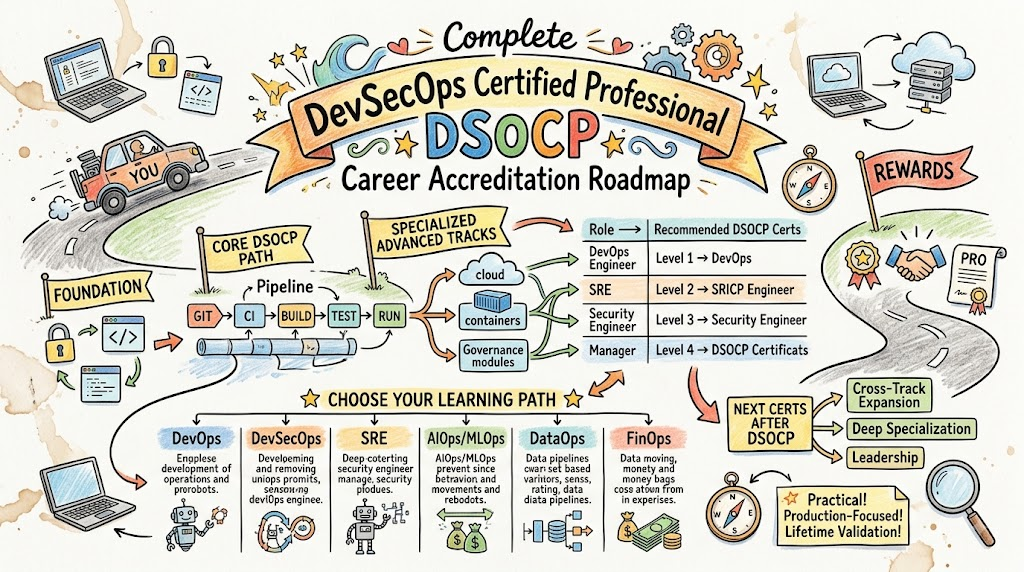
The certification framework provides clear, progressive milestones designed for every stage of an engineer’s career:
- Foundation Level: Introduces core CI/CD mechanics, basic static analysis, dependency tracking, and baseline pipeline automation.
- Professional Level (DSOCP): Validates comprehensive execution across automated vulnerability triage, container image hardening, dynamic testing, and policy-as-code enforcement.
- Architect / Master Level: Emphasizes organizational risk design, multi-cloud zero-trust architectures, automated compliance governance, and enterprise platform security.
Complete DevSecOps Certified Professional (DSOCP) Certification Table
| Track | Level | Who it’s for | Prerequisites | Skills Covered | Recommended Order |
|---|---|---|---|---|---|
| Foundation | Entry | Junior Developers, QA Testers, Associate Engineers | Fundamental Linux and Git commands | SAST, Code Linting, Basic CI/CD | Step 1 |
| Professional (DSOCP) | Intermediate | DevOps, Cloud, SRE, and Security Engineers | Hands-on experience with build pipelines | DAST, SCA, Container Hardening, Policy Engines | Step 2 |
| Master / Architect | Advanced | Principal Architects, Technical Leads, Directors | Advanced system design experience | Threat Modeling, Zero Trust, Runtime Cluster Defense | Step 3 |
Detailed Guide for Each DevSecOps Certified Professional (DSOCP) Level
DevSecOps Certified Professional (DSOCP) – Professional Level
What it is
This intermediate credential validates an engineer’s ability to implement end-to-end security automation across modern continuous delivery pipelines and containerized infrastructure.
Who should take it
DevOps specialists, cloud engineers, security analysts, and platform operators who possess practical delivery pipeline experience and want to lead security automation efforts.
Skills you’ll gain
- Integrate SAST and SCA tools into automated build pipelines.
- Execute dynamic application scans during automated staging deployments.
- Scan container images for vulnerabilities and enforce artifact signing policies.
- Write policy-as-code rules to evaluate Terraform configurations before deployment.
- Implement centralized secrets management and runtime monitoring inside Kubernetes environments.
Real-world projects you should be able to do
- Build a continuous delivery pipeline that blocks deployments whenever dependencies contain critical CVEs.
- Write automated Open Policy Agent (OPA) rules that prevent engineers from provisioning unencrypted cloud storage buckets.
- Configure automated secrets injection for microservices running inside production Kubernetes clusters.
Preparation plan
- 7–14 Days: Study baseline security tools, vulnerability scoring models, and continuous delivery security patterns.
- 30 Days: Build automated pipelines with static analysis tools, scan container registries, and write infrastructure policies.
- 60 Days: Construct complete multi-stage deployment workflows, practice threat modeling exercises, and complete practical mock evaluations.
Common mistakes
- Treating security as an isolated task rather than integrating it into existing developer tooling.
- Overwhelming developer teams with unfiltered, low-priority scan alerts.
- Skipping practical pipeline automation labs in favor of passive reading.
Best next certification after this
- Same-track option: DevSecOps Certified Architect
- Cross-track option: Site Reliability Engineering Certified Professional
- Leadership option: Cloud & Security Engineering Management Practitioner
Choose Your Learning Path
DevOps Path
Engineers in this path build scalable continuous integration pipelines, automate cloud infrastructure provisioning, and accelerate software delivery velocity. They master infrastructure orchestration, automated testing, and multi-cloud operations.
DevSecOps Path
Specialists in this domain embed automated testing, policy engines, and vulnerability scanning directly into deployment pipelines. They ensure that fast-moving development teams release secure code without manual intervention.
SRE Path
Practitioners in this discipline design reliable distributed architectures, establish service level objectives, and automate incident response systems. They treat operational management as a pure software engineering challenge.
AIOps Path
Engineers here deploy machine learning models to analyze infrastructure logs, detect operational anomalies, and filter alert noise across complex enterprise environments. They use predictive insights to prevent production outages.
MLOps Path
Professionals on this track build reliable continuous integration and deployment pipelines specifically for machine learning models. They manage model training workflows, feature stores, and automated model monitoring in production.
DataOps Path
Practitioners in this field apply agile engineering methods to data pipelines. They automate ETL testing, enforce data quality standards, and maintain strict data governance across large-scale storage systems.
FinOps Path
Specialists in this pathway manage cloud expenditures through data-driven optimization strategies. They establish financial accountability, rightsize cloud workloads, and build automated cost-tracking frameworks.
Role → Recommended DevSecOps Certified Professional (DSOCP) Certifications
| Role | Recommended Certifications |
|---|---|
| DevOps Engineer | DevSecOps Certified Professional, CI/CD Security Specialist |
| SRE | DevSecOps Certified Professional, Chaos Engineering Professional |
| Platform Engineer | DevSecOps Certified Professional, Cloud Security Automation Specialist |
| Cloud Engineer | DevSecOps Certified Professional, Infrastructure Security Practitioner |
| Security Engineer | DevSecOps Certified Professional, Application Security Automation Specialist |
| Data Engineer | DevSecOps Certified Professional, Data Pipeline Security Specialist |
| FinOps Practitioner | DevSecOps Certified Professional, Cloud Governance Associate |
| Engineering Manager | DevSecOps Certified Professional, Enterprise DevSecOps Leader |
Next Certifications to Take After DevSecOps Certified Professional (DSOCP)
Same Track Progression
Engineers who desire advanced technical mastery should advance to specialized DevSecOps Architecture and Cloud Defense programs. This pathway develops deep capabilities in zero-trust networking, custom rule development, and multi-tenant security architecture.
Cross-Track Expansion
Gaining expertise in Site Reliability Engineering (SRE) or Platform Engineering complements security capabilities. Engineers who combine high reliability design with automated pipeline security build exceptionally resilient technical platforms.
Leadership & Management Track
Practitioners moving into executive engineering roles should pursue engineering management certifications. These curricula teach risk assessment models, regulatory compliance strategies, and engineering team leadership.
Training & Certification Support Providers for DevSecOps Certified Professional (DSOCP)
The Core Platform Authority
DevOpsSchool delivers industry-leading educational programs across cloud infrastructure, security automation, and modern software operations. The organization provides structured learning tracks, production-grade lab architectures, and expert instructor mentorship. Furthermore, their curriculum emphasizes hands-on mastery over passive theory, enabling engineers to solve complex enterprise problems effectively. Candidates receive ongoing technical support, rigorous examination prep, and industry-recognized credentials that accelerate career advancement across the global technology ecosystem.
Cotocus
Cotocus offers comprehensive enterprise consulting, technical enablement programs, and hands-on operational training across modern DevOps and cloud platforms.
Scmgalaxy
Scmgalaxy operates a massive technical community platform that delivers extensive tutorials, code management guides, and automated software delivery resources.
BestDevOps
BestDevOps publishes technical benchmarks, in-depth tool comparisons, and best-practice frameworks for cloud infrastructure and continuous delivery workflows.
devsecopsschool.com
devsecopsschool.com delivers dedicated training programs focusing on shift-left security, policy-as-code automation, and container runtime defense.
sreschool.com
sreschool.com provides specialized technical training covering production resilience, observability frameworks, incident response, and site reliability engineering.
aiopsschool.com
aiopsschool.com offers focused training on artificial intelligence for IT operations, automated root-cause detection, and intelligent log analytics.
dataopsschool.com
dataopsschool.com trains engineers in automated data pipeline testing, continuous data integration, and enterprise data lifecycle governance.
finopsschool.com
finopsschool.com specializes in cloud financial management, cost allocation strategies, and multi-cloud financial optimization frameworks.
Frequently Asked Questions (General)
1. Which factors determine the difficulty of this certification?
Hands-on lab tasks and real-world scenario challenges determine the examination difficulty, ensuring that candidates prove practical implementation skills.
2. What duration do engineers typically need to complete their preparation?
Most candidates spend four to eight weeks completing practice exercises, studying core modules, and configuring pipelines.
3. Do candidates need specific prerequisites before taking the assessment?
Engineers need no mandatory formal degree, though hands-on experience with Linux systems, Git, and build tools helps immensely.
4. How does this credential accelerate career development?
Certified engineers secure competitive compensation, transition into senior security architecture roles, and stand out during enterprise hiring processes.
5. How does the examination validate technical skills?
The evaluation platform tests candidates through live scenario simulations, automated configuration checks, and practical problem-solving labs.
6. Should software developers pursue this security credential?
Developers gain tremendous value by learning how to catch vulnerabilities early, secure software dependencies, and write hardened code.
7. In what way does this qualification differ from legacy security courses?
Legacy certifications prioritize static audits and theoretical compliance, whereas this program teaches automated, code-level pipeline defense.
8. When do instructors update the core curriculum?
Subject matter experts review the syllabus continuously to reflect modern container technologies, cloud services, and emerging security standards.
9. Do multinational enterprises recognize this credential?
Global technology organizations actively recognize the hands-on competencies verified by this practical assessment program.
10. What sequence should professionals follow when earning infrastructure certifications?
Practitioners usually start with fundamental DevOps practices, earn the DSOCP security credential, and subsequently master SRE or architecture tracks.
11. Does the course include dedicated hands-on cloud environments?
Learners receive access to fully configured cloud sandboxes that simulate real-world continuous deployment workflows.
12. How will these validated skills change daily engineering work?
Graduates eliminate deployment delays, automate repetitive vulnerability triage tasks, and enforce consistent compliance guardrails across development teams.
FAQs on DevSecOps Certified Professional (DSOCP)
1. Which specific tools will candidates master during the program?
Engineers master a broad toolset covering static analysis engines, dependency scanners, container analyzers, dynamic security tools, policy checkers, and secret managers.
2. Does the course cover Kubernetes cluster defense strategies?
The syllabus includes deep modules on container image scanning, admission controllers, service mesh security, and automated runtime cluster auditing.
3. Why do engineers need basic scripting skills for this credential?
Practitioners use Python, Bash, and YAML scripts to build custom automation checks, define delivery pipelines, and manage cloud policies.
4. How does the curriculum teach Infrastructure as Code (IaC) security?
Candidates use automated policy-as-code tools to scan Terraform and CloudFormation templates for insecure configurations before deploying infrastructure.
5. How does this certification support enterprise compliance audits?
Engineers learn to automate audit log generation and policy validation to fulfill standards like SOC2, ISO 27001, and PCI-DSS.
6. Why does the program prioritize practical labs over pure theory?
Practical exercises develop the muscle memory required to troubleshoot complex production incidents and configure robust pipelines under pressure.
7. How do these practices improve development team collaboration?
The methodology introduces lightweight, automated checks that give developers instant feedback without breaking their existing release workflows.
8. Where should certified professionals look for continuous technical growth?
Engineers should contribute to open-source security toolchains, experiment with community policy packages, and study cloud-native security whitepapers.
Final Thoughts: Is DevSecOps Certified Professional (DSOCP) Worth It?
Modern software companies must release features rapidly while safeguarding critical infrastructure against sophisticated supply chain attacks. As a result, organizations urgently seek engineers who know how to automate security checks without creating delivery roadblocks.
Pursuing the DevSecOps Certified Professional (DSOCP) pathway equips you with the exact technical skills that modern engineering teams require. By dedicating your time to this practical, hands-on certification, you build durable expertise that elevates your technical authority and accelerates your career growth.
Leave a Reply