Comprehensive Engineering Guide For Elevating Production Infrastructure With DevOps Support Services
Introduction
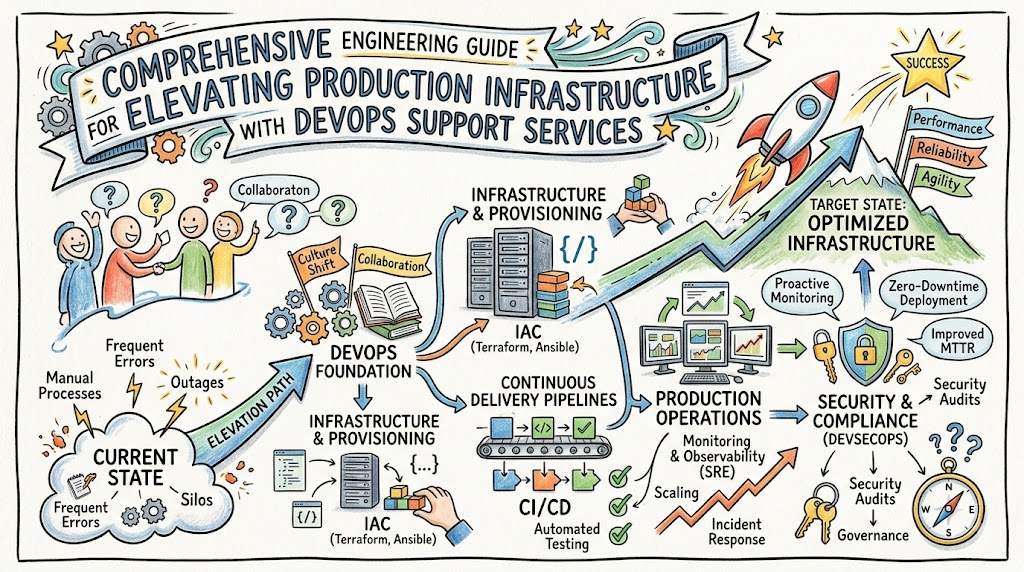
Building resilient software architectures requires continuous operational vigilance and technical mastery. Modern technology stacks depend on automated deployment pipelines, rapid incident mitigation, and proactive system optimization. However, software development teams often experience severe burnout when they balance feature engineering with round-the-clock server maintenance. Consequently, engaging dedicated operational expertise bridges critical technical gaps while preserving internal productivity.
DevOpsSupport empowers technology companies, SaaS platforms, and global enterprises with proactive infrastructure administration. Therefore, engineering leaders eliminate operational bottlenecks without expanding internal hiring budgets. In addition, expert guidance transforms fragile deployment routines into dependable, automated release channels. Furthermore, adopting structured support operations allows developers to dedicate their complete attention toward product innovation.
Understanding The Core Components Of DevOps Support Services
DevOps Support Services deliver comprehensive management across cloud infrastructure, automated software delivery, continuous monitoring, and emergency incident resolution. Additionally, senior operations engineers maintain continuous integration and continuous delivery (CI/CD) pipelines to secure flawless software releases. Therefore, engineering departments avoid costly deployment delays and recover instantly from system failures.
Furthermore, these operational programs manage infrastructure as code (IaC), performance tuning, and cloud governance across diverse platforms. Consequently, enterprise software platforms maintain peak availability, predictable release schedules, and robust system security. In addition, continuous technical upkeep ensures every platform component remains patched, compliant, and cost-effective throughout its entire lifecycle.
The Fundamental Necessity Of Operational Oversight
Unplanned system outages disrupt business revenue, damage user trust, and strain enterprise reputation. Furthermore, modern cloud environments require constant security updates, capacity adjustments, and configuration checks. Therefore, structured technical oversight prevents minor software glitches from escalating into severe system crashes.
Additionally, dedicated operational coverage removes single points of failure within software teams. Furthermore, real-time observability tools catch performance degradation before end users experience service disruptions. Consequently, organizations achieve higher system uptime, smooth software launches, and predictable platform growth without exhausting internal developers.
Strategic Advantages Of 24/7 DevOps Support Services
Deploying 24/7 DevOps Support Services becomes essential when organizations deliver mission-critical digital products to international markets. Furthermore, automated alert notifications without immediate human intervention cause long resolution delays during non-business hours. Therefore, round-the-clock technical monitoring ensures instant intervention during unexpected production emergencies.
In addition, fast-scaling enterprises operating under strict Service Level Agreements (SLAs) benefit enormously from persistent operational supervision. Consequently, internal development teams experience significantly less on-call exhaustion. Furthermore, immediate log analysis and automated recovery protocols protect sensitive databases, microservices, and customer portals at any hour.
Comparing Managed DevOps Services Against Internal Teams
| Operational Dimension | Internal Operations Team | Managed DevOps Services |
|---|---|---|
| Operational Coverage | Standard business hours with rotating on-call | Continuous round-the-clock active monitoring |
| Budget Structure | High fixed payroll, benefits, and recruiting costs | Flexible, predictable monthly investment |
| Tooling Versatility | Restricted to existing internal skill sets | Direct access to multi-cloud engineering experts |
| Capacity Expansion | Slow, expensive recruitment and training cycles | On-demand scalability for fluctuating workloads |
| Incident Management | Dependent on individual developer availability | SLA-backed rapid response protocols |
Selecting Managed DevOps Services allows forward-thinking enterprises to delegate complex infrastructure management to skilled specialists. Therefore, software engineers remain focused on core business logic and customer features.
Essential Elements Of A Comprehensive Support Framework
A successful operational framework integrates proactive infrastructure health management with swift emergency incident response. Furthermore, clear escalation paths and transparent communication channels maintain total operational alignment across technical teams.
Core elements of an effective support model include:
- Proactive Observability: Continuous system monitoring using enterprise telemetry tools.
- Automated Workflow Maintenance: Ongoing maintenance for Jenkins, GitHub Actions, and GitLab pipelines.
- Security Policy Enforcement: Continuous vulnerability assessment, access control, and secrets management.
- Structured SLA Commitments: Clear response tiers that define exact resolution timelines.
- Disaster Recovery Preparedness: Automated Terraform scripts, regular database backups, and restoration tests.
Evaluating A DevOps Support Company India For Global Scale
Choosing a top-tier DevOps Support Company India requires a detailed analysis of technical expertise, security standards, and operational maturity. Furthermore, business executives should verify whether the service partner offers customizable engagement models that match specific infrastructure demands.
Key evaluation criteria include:
- SLA Guarantees: Proven uptime benchmarks, fast response times, and clear escalation protocols.
- Compliance Standards: Strict adherence to international data protection, security frameworks, and encryption standards.
- International Execution: A strong record of managing multi-region cloud deployment setups for global clients.
- Cost Transparency: Straightforward service packages without unexpected operational fees.
- Multi-Cloud Expertise: Comprehensive mastery over Kubernetes, AWS, Azure, Terraform, and MLOps tools.
Scaling Container Workloads With Kubernetes Support Services
Managing containerized applications provides immense scalability, yet complex cluster management introduces significant operational hurdles. Therefore, our Kubernetes Support Services guide technology teams through cluster upgrades, node pool management, ingress control, and service mesh management.
Furthermore, cloud engineers fine-tune container resource limits to eliminate compute waste and lower infrastructure spending. Consequently, applications maintain exceptional resilience through automated self-healing and horizontal pod autoscaling. In addition, experienced specialists resolve cluster networking, storage volume claims, and pod security policies quickly.
Optimizing Cloud Architectures With AWS DevOps Support Services
Running applications on Amazon Web Services demands precise knowledge of cloud-native architectures, security policies, and automation tools. Therefore, our AWS DevOps Support Services manage EKS clusters, ECS containers, EC2 instances, Lambda functions, CloudFormation templates, and modular Terraform scripts.
Furthermore, operational engineers conduct routine cloud spend audits to eliminate unused resources and leverage cost-saving instance options. Consequently, businesses reduce overall cloud expenditure while optimizing application performance. In addition, centralized CloudWatch logging guarantees immediate detection of system anomalies.
Streamlining Microsoft Environments With Azure DevOps Support Services
Enterprise organizations operating within the Microsoft ecosystem require tight synchronization between pipeline tools and cloud resources. Therefore, our Azure DevOps Support Services oversee Azure Pipelines, Azure Kubernetes Service (AKS), resource groups, and automated enterprise release cycles.
Furthermore, security experts enforce strict identity governance through Azure Active Directory and Key Vault integrations. Consequently, release engineering teams push code updates safely across staging and live production systems. In addition, active infrastructure tracking prevents failed deployments and minimizes service interruptions during peak traffic.
Fortifying Release Pipelines With DevSecOps Support Services
Embedding security controls directly inside delivery pipelines prevents application vulnerabilities from reaching live production environments. Therefore, our DevSecOps Support Services insert automated security scanners, dependency audits, and container inspection tools directly into CI/CD workflows.
Furthermore, system administrators enforce secure secrets distribution through central vault management and strict policy enforcement. Consequently, security compliance becomes a seamless, automated routine rather than an operational roadblock. In addition, rapid patching processes protect cloud environments from newly discovered security exploits.
Maximizing System Uptime With SRE Support Services
Site Reliability Engineering combines software development principles with operational practices to build resilient enterprise systems. Therefore, our SRE Support Services establish precise Service Level Indicators (SLIs) and Service Level Objectives (SLOs) to measure system performance continuously.
Furthermore, reliability engineers manage error budgets to balance rapid feature releases with overall application stability. Consequently, automated incident response workflows drastically reduce Mean Time to Resolution (MTTR). In addition, proactive capacity planning prevents performance drops during massive traffic spikes.
Accelerating Production Machine Learning With MLOps Support Services
Deploying machine learning models to production environments requires continuous data pipeline monitoring and model tracking. Therefore, our MLOps Support Services support ML infrastructure, feature repositories, automated retraining workflows, and production model performance tools.
Furthermore, operations teams eliminate data drift issues and preserve ultra-low inference latency across live API endpoints. Consequently, data science teams concentrate on model training while system engineers ensure dependable compute scaling. In addition, structured workflows standardise model migration from development notebooks to high-availability production clusters.
Practical Operational Transformation In Action
Imagine a rapidly expanding SaaS company struggling with frequent service slowdowns during user onboarding surges. Initially, their internal developers managed cloud servers manually, which led to fragile deployments, delayed bug fixes, and severe team fatigue.
After partnering with DevOpsSupport, the organization modernized its infrastructure using automated Terraform code and managed Kubernetes clusters. Furthermore, round-the-clock monitoring identified memory leaks before they impacted end users, while automated deployment pipelines reduced release failures by 80%. Consequently, platform uptime rose to 99.99%, enabling the development team to launch new features twice as fast.
Building A Sustainable DevOps Support Strategy
Designing a robust operational strategy requires clear planning, proper tool adoption, and consistent process standardization. Therefore, engineering leaders should follow a structured roadmap to align infrastructure practices with long-term business goals.
- Analyze Operational Gaps: Pinpoint pipeline delays, monitoring blind spots, and incident response failures.
- Standardize Infrastructure Deployment: Automate cloud provisioning using modular, reusable code templates.
- Integrate Automated Security Checks: Incorporate static security scanning and code analysis into every build phase.
- Unify Observability Tools: Consolidate system logs, metrics, and application traces into a centralized dashboard.
- Establish Incident Escalations: Define strict SLA guidelines and automated notification paths for emergency outages.
Minimizing Operational Overhead Through Shared Expertise
Maintaining full-time internal engineering teams for round-the-clock coverage creates heavy payroll, healthcare, and continuous training expenses. Furthermore, sudden employee turnover creates critical knowledge gaps that jeopardize overall operational stability.
External support models eliminate these heavy overhead expenses through shared engineering resources and proven practices. Therefore, businesses invest only in the exact operational capacity they require while retaining immediate access to senior architects. Consequently, companies redirect financial savings toward strategic product initiatives and market expansion.
Identifying Key Indicators For External Operational Help
Recognizing the exact moment to transition toward external technical assistance prevents costly service outages. Therefore, engineering executives should evaluate internal productivity metrics regularly to catch operational bottlenecks early.
Organizations should seek specialized external assistance when experiencing these challenges:
- Software developers allocate more time to server maintenance than writing product code.
- Repeated release rollbacks interrupt active user workflows during business hours.
- Critical production outages occur during off-hours without immediate engineer response.
- Monthly cloud bills increase rapidly without corresponding business growth.
- Managing complex multi-cloud or Kubernetes setups exceeds internal team knowledge.
Advantages Of Partnering With Dedicated Operations Experts
Navigating modern cloud complexity demands deep technical specialization and constant hands-on experience with emerging software tools. Therefore, a specialized partner brings industry-tested operational blueprints, disaster recovery plans, and refined incident management workflows.
DevOpsSupport functions as a seamless extension of your internal team, offering expert support across AWS, Azure, Kubernetes, DevSecOps, SRE, and MLOps frameworks. Furthermore, dedicated service arrangements ensure immediate response times, proactive infrastructure health checks, and continuous performance tuning. Consequently, business leaders build scalable, secure digital platforms with total confidence.
Frequently Asked Questions About DevOpsSupport
- What primary solutions does DevOpsSupport deliver to technology organizations?
DevOpsSupport delivers automated infrastructure provisioning, 24/7 cloud monitoring, CI/CD pipeline management, Kubernetes orchestration, cloud security, SRE practices, and rapid emergency incident handling for growing software teams.
- How do round-the-clock monitoring operations support global companies?
Dedicated operations engineers monitor system health continuously, utilizing real-time telemetry and structured SLA escalation protocols to resolve infrastructure issues instantly across all global timezones.
- Can external specialists manage our existing multi-cloud environments?
Yes, senior engineers audit current cloud configurations across AWS, Azure, or Google Cloud, refine delivery pipelines, and modernize infrastructure without disrupting live customer operations.
- What response times apply during sudden production outages?
Critical incident response protocols guarantee that specialized engineers engage within 15 to 30 minutes, keeping application downtime and business impact to a minimum.
- How does DevOpsSupport maintain robust enterprise data security?
Engineering processes follow rigorous security standards, enforcing zero-trust access rules, automated vulnerability scans, encrypted data channels, and strict credential management across all environments.
- How does SRE support differ from basic cloud administration?
SRE support emphasizes reliability engineering, error budget tracking, SLI/SLO metrics, and automated disaster recovery, whereas basic cloud administration handles routine server maintenance and basic tasks.
- How do Kubernetes support programs assist with complex container clusters?
Specialists take charge of cluster provisioning, automated version updates, ingress routing, pod autoscaling, security policy management, and deep troubleshooting to keep containerized applications stable.
- Can operational service models scale as user traffic grows?
Yes, engagement plans scale seamlessly, allowing businesses to adjust dedicated engineering capacity, coverage windows, and architectural consulting as operational demands increase.
- How do dedicated operations teams help control monthly cloud expenses?
Engineers perform continuous resource utilization audits, deactivate idle cloud assets, automate resource scaling, and implement reserved pricing models to lower monthly infrastructure costs.
- Why should engineering leaders choose specialized support over full-time hiring?
Specialized partners provide immediate access to broad multi-cloud expertise, 24/7 coverage, and reduced operational costs without the prolonged hiring timelines and salary burdens of full-time recruiting.
Final Thoughts
Achieving continuous software innovation while maintaining top-tier system availability requires strict operational discipline and modern infrastructure strategies. As cloud applications grow more complex, depending solely on internal developers for round-the-clock maintenance creates operational bottlenecks and severe developer fatigue. Furthermore, implementing structured operational support guarantees maximum system uptime, rapid incident mitigation, and efficient cloud spending.
DevOpsSupport empowers modern technology businesses by managing cloud infrastructure, security frameworks, container platforms, and continuous delivery systems. Therefore, internal development teams focus completely on feature creation while expert engineers protect platform health and performance. Partnering with a dedicated operational specialist ultimately provides the strong technical foundation required for sustainable digital scaling.
Leave a Reply