Delivers Complete Practical Mastery For Modern Enterprise Cloud Security Engineering
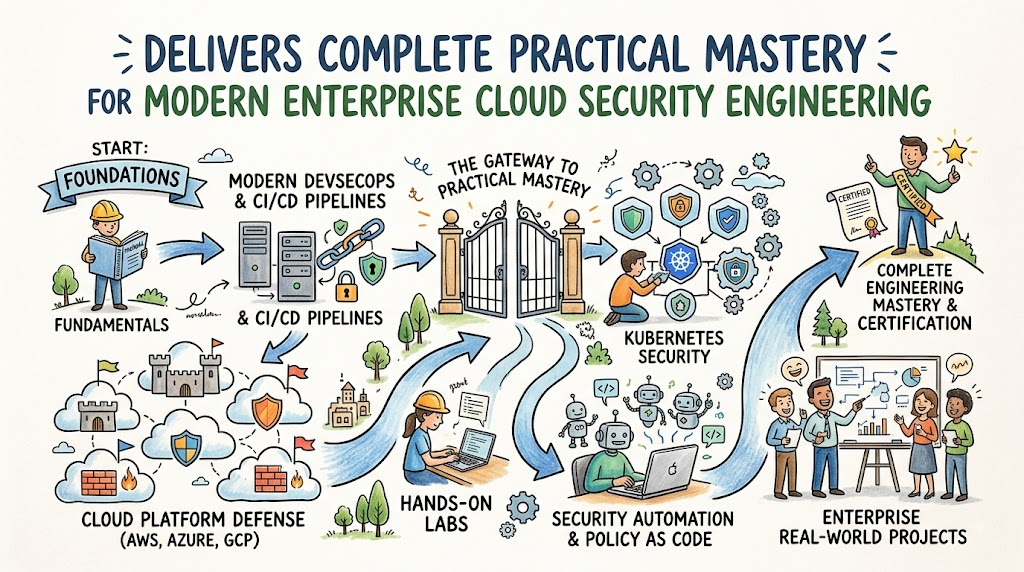
Transforming Application Delivery Through Integrated Cloud Defense
Accelerating digital release cycles often creates severe friction between rapid innovation and resilient defense. When engineering teams push features without automated security oversight, critical flaws inevitably reach live production servers. Consequently, organizations face emergency patches, costly downtime, and elevated breach risks.
DevSecOps solves this operational challenge by embedding security controls directly into daily developer workflows. Furthermore, mastering these integrated practices requires structured hands-on guidance with enterprise tools. Completing a structured DevSecOps Course gives developers and operations specialists the actionable skills to secure cloud-native environments from initial code commit to production monitoring.
Core Foundations Of Continuous Software Protection
Modern application defense requires development, security, and operations teams to share accountability across the entire software delivery lifecycle. In traditional workflows, external security analysts evaluated applications manually right before release, creating massive delivery bottlenecks. In contrast, DevSecOps introduces continuous automated checks that provide immediate feedback to developers.
+-------------------------------------------------------------------------------+
|                       CONTINUOUS SECURITY INTEGRATION                         |
|                                                                               |
|  [ Write Code ]   -->   [ Trigger CI ]   -->   [ Deploy CD ]   -->  [ Audit ] |
|        |                      |                       |                |      |
|  Threat Modeling       SAST & SCA Scans        IaC & Secret Scans   CSPM & APM|
+-------------------------------------------------------------------------------+
Therefore, software teams catch flaws before code merges into main production branches. Moreover, this early remediation drastically slashes development expenses, as early bug fixes cost a fraction of post-launch emergency remediation.
| Delivery Phase | Cost Impact | Engineering Activity |
|---|---|---|
| Planning & Coding | Baseline Cost | Immediate inline syntax correction |
| Build & Testing | Moderate Cost | Dependency updates and automated unit scans |
| Production Runtime | Severe Cost | Critical hotfixes, incident response, rollbacks |
Engineering Automated CI/CD Pipelines With Shift-Left Tooling
Integrating automated scanners into continuous delivery pipelines allows engineering squads to release code rapidly without sacrificing quality. Developers trigger static analyzers and third-party dependency monitors automatically whenever they submit a pull request.
+-------------------------------------------------------------------------------+
|                      AUTOMATED PIPELINE QUALITY GATE                          |
|                                                                               |
|  [ Developer Pull Request ]                                                   |
|             |                                                                 |
|             v                                                                 |
|  [ CI Runner Executes Scanners ] (SAST: Semgrep | SCA: Snyk)                  |
|             |                                                                 |
|             v                                                                 |
|  [ Quality Gate Evaluation ]  ---> High Severity CVE Found? -> Fail Build     |
|             |                                                                 |
|         (Passed)                                                              |
|             v                                                                 |
|  [ Image Scan & Artifact Storage ] (Trivy Container Scan)                     |
|             |                                                                 |
|             v                                                                 |
|  [ Cloud Infrastructure Deployment ] (Terraform Security Validation)          |
+-------------------------------------------------------------------------------+
Additionally, automated quality gates reject builds that contain high-severity vulnerabilities or exposed secrets. Consequently, engineers fix flaws within their standard development environment, eliminating manual handoffs and speeding up delivery.
Enforcing Declarative Governance Through Policy As Code
Policy as Code empowers security architects to write programmatic governance rules that automated systems enforce across all delivery environments. Rather than reading dense compliance manuals, developers run automated validation checks against their infrastructure blueprints.
- Automated Guardrails: Tools like Open Policy Agent evaluate configuration files against defined security baselines.
- Misconfiguration Blocking: Scanners instantly flag unencrypted storage buckets and overly permissive network rules before provisioning.
- Uniform Standards: Platform teams maintain identical security parameters across development, staging, and production clusters.
Thus, organizations eliminate configuration drift and prevent human error from compromising live cloud services.
Hardening Container Workloads And Cloud Infrastructure
Containerized microservices demand multi-layered operational protection because conventional operating system firewalls cannot isolate container runtimes effectively. Teams must enforce pod security standards, manage cluster permissions, and inspect container images continuously.
+-------------------------------------------------------------------------------+
|                       MULTI-LAYER WORKLOAD HARDENING                          |
|                                                                               |
|  Layer 1: Identity Access    --> Fine-Grained Role-Based Access Control       |
|  Layer 2: Policy Enforcement --> OPA Gatekeeper Admission Control             |
|  Layer 3: Secret Injection   --> Dynamic HashiCorp Vault Secrets              |
|  Layer 4: Network Isolation  --> Microsegmentation & Strict Ingress Rules     |
|  Layer 5: Runtime Auditing   --> Real-Time Behavioral System Call Monitoring  |
+-------------------------------------------------------------------------------+
Participating in comprehensive Kubernetes Security Training equips engineers with the practical capabilities to configure granular Role-Based Access Control and implement real-time threat detection. Furthermore, combining these practices with Cloud Security Posture Management safeguards multi-cloud environments from sophisticated external intrusions.
Practical Vulnerability Remediation And Continuous Compliance
Effective vulnerability management prioritizes flaws based on real-world reachability and business impact rather than raw alert volume. Generic scanners often flood engineers with thousands of cosmetic notifications, causing severe alert fatigue.
+-------------------------------------------------------------------------------+
|                      CONTEXTUAL VULNERABILITY TRIAGE                          |
|                                                                               |
|  Raw Scanner Alerts  --> Reachability Analysis --> Business Context Evaluation|
|                                                          |                    |
|                                                          v                    |
|  Remediated Code  <-- Jira Ticket Dispatched  <-- Actionable High-Risk Flaw   |
+-------------------------------------------------------------------------------+
To resolve this issue, security teams implement contextual scoring algorithms that pinpoint exploitable code paths. In addition, compliance automation tools continuously audit cloud infrastructure against SOC 2, ISO 27001, and PCI-DSS standards, generating verifiable compliance evidence without manual spreadsheet tracking.
Fostering High-Performing Collaborative Security Cultures
Successful security transformations require open communication and shared ownership across traditionally separated technical departments. When leadership treats security as an isolated auditing department, developers often perceive guidelines as frustrating blockers.
+-------------------------------------------------------------------------------+
|                        SECURITY CHAMPION ARCHITECTURE                         |
|                                                                               |
|                    [ Central Security Governance ]                            |
|                                  |                                            |
|                 +----------------+----------------+                           |
|                 |                                 |                           |
|                 v                                 v                           |
|      [ Security Champion ]             [ Security Champion ]                  |
|      Feature Squad Alpha               Feature Squad Beta                     |
|                 |                                 |                           |
|                 v                                 v                           |
|      (Inline Threat Modeling)          (Pipeline Gate Tuning)                 |
+-------------------------------------------------------------------------------+
Forward-thinking organizations cultivate Security Champions inside individual development squads to bridge this organizational gap. These champions facilitate threat modeling, assist peers during code reviews, and streamline scanner tuning. Consequently, security becomes an intrinsic engineering habit rather than an external enforcement mechanism.
Avoiding Critical Implementation Roadblocks And Operational Traps
Organizations frequently encounter painful setbacks when rolling out automated security tooling without a clear operational roadmap.
- Excessive Tooling Overload: Launching multiple aggressive scanners simultaneously overwhelms developers with noisy false positives.
- Premature Build Blocking: Halting pipelines on minor informational warnings frustrates developers and tempts them to bypass gates.
- Tooling Silos: Buying modern security software without training internal engineering staff results in abandoned licenses.
- Neglecting Culture: Focusing purely on software integrations while ignoring inter-team collaboration stalls operational transformation.
Hence, engineering leaders must introduce automated gates gradually, tuning rule sets to match team maturity levels.
Specialized Professional Learning Paths And Enterprise Enablement
Technical professionals require practical, hands-on learning paths tailored to their specific operational responsibilities.
+-------------------------------------------------------------------------------+
|                        ROLE-BASED LEARNING PATHWAYS                           |
|                                                                               |
|  Developers          --> SAST Scanners + Dependency Remediation + Secret Hygiene
|  DevOps Engineers    --> CI/CD Security Gates + IaC Scanners + Vault Management
|  Security Analysts   --> Policy as Code + Dynamic DAST Automation + Auditing  |
|  Cloud Architects    --> Kubernetes RBAC + Multi-Cloud Posture Hardening      |
+-------------------------------------------------------------------------------+
- Interactive Hands-On Instruction: Practical DevSecOps Training provides sandbox cloud laboratories where engineers remediate real vulnerabilities in live deployment pipelines.
- Scalable Workforce Enablement: Organizations utilize customized Corporate DevSecOps Training to upskill distributed engineering units on their specific enterprise technology stacks.
- Flexible Global Access: Distributed teams leverage DevSecOps Online Training to attend live interactive masterclasses from any location worldwide.
- Regional Technology Excellence: Professionals elevate their regional engineering capabilities through dedicated DevSecOps Training in India, unlocking premium roles across top multinational tech firms.
Career Acceleration Via Industry-Recognized Credentials
Validating your engineering capabilities through a respected DevSecOps Engineer Certification proves your ability to secure enterprise pipelines effectively. Hiring managers actively search for practitioners who demonstrate hands-on competence in automating security controls.
| Professional Milestone | Key Technical Competencies | Career Impact |
|---|---|---|
| Associate Security Practitioner | Static scanning, basic CI/CD gates, secret detection | Entry into automated pipeline security |
| Lead DevSecOps Specialist | IaC hardening, Policy as Code, container security | Senior engineering & pipeline governance roles |
| Certified DevSecOps Professional | Multi-cloud CSPM, Kubernetes defense, compliance automation | Principal architect & technical leadership |
Pursuing intensive DevSecOps Certification Training prepares candidates to architect, test, and protect modern cloud-native systems with complete professional confidence.
Practical DevSecOps Learning Methodologies And Tool Ecosystem
DevSecOpsSchool delivers a comprehensive curriculum that immerses students directly into real-world cloud architectures. Rather than relying on abstract slide presentations, learners configure industry-standard tooling inside live production environments.
- Source Code & Artifact Security: Master SonarQube, Semgrep, Snyk, and Trivy for comprehensive code and container inspection.
- Pipeline Automation: Build secure workflows using Jenkins, GitHub Actions, and GitLab CI.
- Dynamic Testing & Secrets Management: Deploy OWASP ZAP and HashiCorp Vault across distributed services.
- Infrastructure & Policy as Code: Enforce guardrails using Terraform, Checkov, and Open Policy Agent.
Consequently, graduates gain the practical expertise and technical confidence required to lead enterprise security initiatives.
Frequently Asked Questions About DevSecOpsSchool
1. What technical background helps students succeed in this program?
Familiarity with basic Linux system commands, Git version control workflows, and general software development or systems administration concepts provides a solid foundation.
2. Which automation tools do students configure during practical labs?
Students gain direct experience with SonarQube, Semgrep, Snyk, OWASP ZAP, Trivy, Docker, Kubernetes, Terraform, Checkov, HashiCorp Vault, and Open Policy Agent.
3. How do participants access the practical laboratory environments?
Learners log into cloud-hosted sandbox environments directly through their web browsers to build pipelines, scan infrastructure, and harden container clusters in real time.
4. Can working professionals complete this curriculum alongside full-time jobs?
Yes, interactive instructor-led classes take place during convenient weekend and evening schedules, supported by complete session recordings and self-paced lab access.
5. How does DevSecOps differ from traditional DevOps methodologies?
Traditional DevOps focuses primarily on delivery speed and automation, while DevSecOps incorporates automated security validation and compliance controls directly into every development stage.
6. Does the curriculum provide dedicated container security training modules?
Yes, the course includes extensive exercises covering container image scanning, admission controllers, Kubernetes network policies, RBAC configurations, and runtime monitoring.
7. How does earning a professional certification advance an engineering career?
Obtaining a verified credential demonstrates practical technical mastery to prospective employers, significantly boosting qualification for senior cloud security engineering roles.
8. Can companies tailor the corporate training syllabus to their internal tech stacks?
Yes, enterprise training modules adapt directly to match an organization’s specific cloud platforms, continuous integration tools, and internal governance frameworks.
9. How do students resolve vulnerabilities during the hands-on project assignments?
Participants analyze scanner outputs, patch vulnerable dependencies, adjust infrastructure templates, update policy rules, and verify that pipelines clear all automated quality gates.
10. What long-term educational resources do graduates receive after course completion?
Graduates retain ongoing access to lab documentation, reference architecture guides, active peer discussion communities, and career mentorship support from experienced industry instructors.
Strategic Roadmaps For Resilient Enterprise Engineering
Safeguarding modern cloud platforms demands that engineering organizations weave security automation directly into every stage of their delivery lifecycle. When development, security, and operations teams collaborate using automated scanners, policy-as-code engines, and secure container runtimes, they release reliable software at unprecedented speed.
Investing in structured hands-on education builds the verified practical competencies necessary to defend complex cloud environments against evolving threats. Begin your educational journey with DevSecOpsSchool to master continuous pipeline protection, earn recognized industry credentials, and advance your engineering career.
Leave a Reply