Mastering Production Engineering Systems and Modern Automation Across China
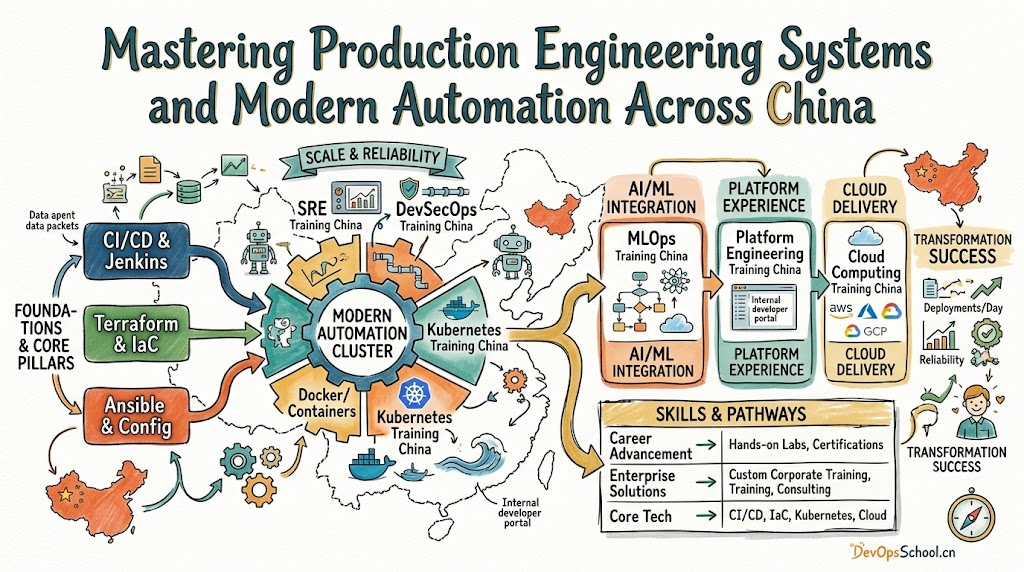
Introduction
Rapid software delivery requires engineering leaders to eliminate friction between code development and runtime operations. When cross-functional squads embrace automated execution, organizations dramatically accelerate product release velocity. Technical teams modernize legacy systems by replacing fragmented handoffs with cohesive delivery pipelines.
Modern engineering practices bridge the gap between creative problem-solving and stable platform management. Through hands-on mastery of cloud orchestration and automated quality gates, developers eliminate costly operational bottlenecks. Therefore, forward-looking enterprises continually cultivate advanced technical capabilities across their digital workforce to sustain peak operational resilience.
What Is DevOps and Why Does It Matter Today?
DevOps establishes an operational paradigm where software creation and platform administration merge into a unified workflow. Product teams eliminate historic departmental barriers and take complete ownership of features throughout their entire operational life. As customer expectations escalate, engineering units release reliable code updates rapidly rather than enduring grueling quarterly deployment cycles.
Automation eliminates human error and drastically decreases deployment overhead across production environments. Developers run tests, package artifacts, and verify system integrity through automated execution steps. Consequently, organizations achieve faster release iterations, preserve code quality, and maintain superior customer satisfaction.
Core Components of a Modern DevOps Environment
Constructing an enterprise-grade delivery framework requires several interconnected technical capabilities operating simultaneously. Distributed version control systems track configuration alterations and software source files with absolute precision. Concurrently, automated verification stages inspect each commit before workloads advance toward runtime targets.
Centralized telemetry solutions monitor cluster performance, network health, and system resource consumption across distributed architectures. By integrating declarative provisioning, container packaging, and trace analysis, organizations gain comprehensive visibility into their application stack. This deep observability enables platform engineers to resolve system degradation before disruptions impact daily end users.
How CI/CD Improves Software Delivery
Automated integration and deployment pipelines fundamentally upgrade how technology teams distribute features. Instead of managing high-risk manual updates during late-night maintenance hours, engineers deploy modular changes through automated delivery workflows. Consequently, every code commit automatically triggers static analysis, unit testing, and artifact builds.
These automated workflows provide developers with instantaneous feedback on code performance. When an automated test detects a regression, programmers rectify the issue immediately while the context remains clear. Therefore, engineering groups replace exhausting deployment marathons with continuous, predictable, and stress-free daily releases.
Why Infrastructure as Code Matters
Manual system configuration inevitably creates architectural drift and unmanageable environment discrepancies. Conversely, modern infrastructure teams treat cloud resources, private networks, and data storage systems as version-controlled code. By utilizing declarative configuration tools, engineers maintain complete blueprints of production environments inside shared repositories.
Teams rapidly provision, destroy, and rebuild complex runtime clusters with absolute consistency. When hardware failures compromise a cluster, automated scripts recreate the identical infrastructure configuration without guesswork. Ultimately, declarative infrastructure guarantees repeatable deployments, comprehensive auditability, and rock-solid platform reliability.
Containers and Kubernetes in Modern Engineering
Container technology ensures software applications execute identically across personal laptops, testing stages, and production servers. By packaging application code, shared libraries, and dependencies together, teams eradicate environment-specific runtime defects. However, managing hundreds of microservices creates significant infrastructure complexity.
Through intensive Kubernetes Training China, technical professionals master container scheduling, dynamic load balancing, and self-healing cluster operations. Platform engineers implement declarative controllers, traffic routing, and stateful storage orchestration across distributed fleets. These capabilities allow enterprises to run mission-critical cloud-native workloads with supreme operational precision.
Understanding Site Reliability Engineering
Site Reliability Engineering applies software engineering principles directly to systems operations problems. Rather than merely reacting to hardware outages, reliability teams define precise Service Level Indicators and manageable error budgets. Consequently, product managers balance rapid feature delivery against stringent platform availability targets.
Pursuing specialized SRE Training China equips system operators to eliminate repetitive manual operational tasks systematically. Engineers architect resilient alerting frameworks, automated recovery controllers, and blameless retrospective processes. Therefore, enterprises limit unplanned downtime and deliver seamless digital experiences during extreme demand spikes.
Bringing Security Into the Development Lifecycle
Modern vulnerability landscapes require development groups to reject traditional, late-stage security audits. Waiting until the eve of production release to identify vulnerabilities introduces severe delivery delays and leaves platforms exposed. Modern security teams integrate vulnerability management directly into early engineering stages.
Through comprehensive DevSecOps Training China, engineers embed static source analysis, container vulnerability scanning, and automated secrets rotation into active pipelines. Security scans run continuously during standard continuous integration routines. Teams construct robust, zero-trust architectures naturally without impeding feature development velocity.
Cloud Computing and Modern Infrastructure
Cloud platforms provide the essential dynamic computing resources that power modern enterprise applications. Instead of managing physical data centers and long hardware procurement cycles, teams provision global infrastructure instantly. Nevertheless, distributed cloud adoption introduces intricate challenges regarding resource governance, cost control, and network security.
Mastering advanced Cloud Computing Training China empowers architects to design secure, fault-tolerant multi-cloud and hybrid environments. Engineers acquire deep expertise in elastic compute instances, managed database services, and automated network policies. As a result, businesses maximize their computing efficiency while enforcing enterprise-level data compliance.
Platform Engineering and Developer Experience
As modern software architectures grow more complex, individual developers suffer from excessive operational cognitive load. Expecting programmers to master complex container manifests, network policies, and pipeline scripting slows feature delivery. To solve this problem, dedicated platform teams build internal developer platforms.
Participating in targeted Platform Engineering Training China prepares engineers to design intuitive self-service golden paths. Infrastructure specialists create standardized deployment modules that automate resource allocation safely. Consequently, software developers ship applications autonomously without relying on operational handoffs.
The Rise of MLOps
Machine learning models generate actual enterprise value only when they run reliably within production applications. Transitioning algorithms from experimental notebooks into high-performance web systems demands rigorous engineering standards. Data teams must track model provenance, validate raw input data, and monitor dynamic inference performance.
Enrolling in comprehensive MLOps Training China provides engineers with the skills to automate data pipelines and model deployment lifecycles. Specialists manage centralized feature stores, orchestrate distributed model training, and detect production accuracy drift. As a result, enterprises operationalize intelligent algorithmic systems smoothly and safely.
Building an Effective DevOps Learning Roadmap
Mastering the vast landscape of modern platform engineering requires a deliberate, step-by-step learning strategy. Beginners often become confused by trying to learn complex open-source tools without understanding foundational concepts. Successful engineers prioritize fundamental systems management before adopting advanced orchestration frameworks.
Follow this sequential progression to build robust operational fluency:
- System Core: Master Linux operating system concepts, shell scripting, and distributed Git collaboration.
- Pipeline Automation: Build automated testing stages, continuous delivery pipelines, and container image workflows.
- Infrastructure Management: Implement declarative Infrastructure as Code and automate virtualized cloud topologies.
- Distributed Orchestration: Master production Kubernetes operations, cluster networking, and service mesh routing.
- Operational Excellence: Deploy comprehensive telemetry platforms, site reliability practices, and automated security controls.
Individual Learning vs Enterprise Training
Independent learners frequently face roadblocks because public tutorials employ overly simplified playground environments. Production platforms involve legacy enterprise code, restrictive network perimeters, and demanding compliance guidelines. Without practical mentoring, individual developers often adopt architectural shortcuts that trigger production failures.
The following breakdown illustrates how individual study compares to structured enterprise instruction:
| Capability Dimension | Independent Study | Enterprise Training Model |
|---|---|---|
| Curriculum Structure | Fragmented topics and random guides | Systematic, role-oriented learning path |
| Laboratory Infrastructure | Basic single-node local machines | Multi-tier, production-grade cloud environments |
| Architectural Feedback | None or inconsistent forum advice | Direct code reviews from senior platform architects |
| Team Alignment | Isolated individual skills | Shared terminology and unified deployment standards |
| Technology Focus | Generic, standalone open-source tools | Direct alignment with active company technology stacks |
Deploying custom Corporate DevOps Training China solves this organizational challenge by aligning technical training with active architectural goals. Engineering squads adopt uniform automation methods, resolve deep infrastructure bottlenecks, and elevate enterprise delivery speed collectively.
When Organizations Need DevOps Consulting
Even experienced technology teams encounter severe friction when modernizing enterprise infrastructure. Monolithic codebases, manual compliance reviews, and fragmented development tools frequently paralyze release cadence. When leadership teams struggle to identify why deployments fail repeatedly, external domain guidance becomes essential.
Engaging targeted DevOps Consulting China allows leadership to assess current delivery bottlenecks accurately. Seasoned consultants audit deployment architectures, implement modern GitOps delivery patterns, and break down organizational friction. This outside perspective guides technology teams through digital transformations without costly architectural mistakes.
How to Choose the Right DevOps Training Program
Selecting an effective technical development program requires careful evaluation of instructional design. Students should avoid programs that rely strictly on passive video presentations and theoretical quizzes. True technical competence demands active problem-solving within real cloud infrastructure.
High-impact DevOps Training China programs emphasize extensive practical exercises over theoretical lectures. Learners configure continuous delivery pipelines, resolve simulated Kubernetes cluster outages, and provision live cloud infrastructure via code. Consequently, engineers develop the genuine troubleshooting intuition needed to handle mission-critical production incidents.
Common Mistakes When Learning DevOps
Aspiring platform specialists frequently mistake tool syntax memorization for real engineering capability. Learning individual tools without understanding foundational operational theory produces fragile, unmaintainable delivery systems. Tools update frequently, but underlying distributed systems patterns persist across generations.
Furthermore, learners often ignore system observability, logging, and production troubleshooting methods. Deploying a container represents only the beginning of the operational lifecycle; keeping it healthy requires proactive monitoring and automated remediation. Combining continuous deployment skills with rigorous observability safeguards systems against crippling outages.
Practical Skills That Matter in Production
Hiring managers consistently look beyond conceptual knowledge during rigorous technical evaluations. They seek professionals who demonstrate exceptional systems troubleshooting skills and robust automation fluency. Candidates must prove they can stabilize degraded cloud clusters under high-pressure enterprise conditions.
Essential technical capabilities include:
- Idempotent Provisioning: Developing declarative scripts that ensure identical infrastructure configurations across environments.
- Pipeline Security: Hardening integration workflows with automatic vulnerability scanning, policy checks, and secret controls.
- Telemetry Architecture: Designing distributed trace systems, aggregated log platforms, and custom business metrics.
- Operational Recovery: Conducting incident post-mortems and building self-healing automation controllers.
DevOps Career Opportunities in China
Enterprises across China continue to accelerate digital transformation initiatives, generating immense demand for elite platform engineers. E-commerce platforms, financial institutions, and telecommunications leaders continually modernize their software distribution networks. Consequently, platform architects and reliability engineers secure highly rewarding careers throughout the technology sector.
Earning a credible DevOps Certification China credential verifies technical mastery to corporate engineering teams. Certified engineers stand out by demonstrating their ability to architect, automate, and protect enterprise cloud infrastructure. These specialized capabilities unlock senior platform engineering, SRE, and cloud operations roles.
Why Practical Learning Is Important
Systems engineering is an intensely practical craft that rewards hands-on experience. Reading technical documentation provides valuable architectural context, but true intuition develops when complex pipelines break. Diagnosing configuration mismatches and network deadlocks under time constraints produces deep engineering confidence.
Furthermore, authentic laboratory scenarios replicate the chaotic edge cases that occur within enterprise production environments. Learners restore degraded microservices, fix pipeline security violations, and resolve conflicting infrastructure state files. This practical experience ensures engineers integrate into production operations without hesitation.
DevOpsSchool Learning With a Practical Focus
Educational programs must bridge the divide between theoretical architecture and real production execution. By immersing students in live, hands-on enterprise cloud environments, our instructors cultivate deep problem-solving skills across every layer of the delivery stack. Seasoned industry mentors guide engineers through practical architectural dilemmas and real-world system failures.
Furthermore, learners engage in end-to-end operational implementations spanning container orchestration, cloud-native observability, and automated infrastructure governance. Participants build functional continuous delivery ecosystems, automate multi-region cluster failovers, and implement rigorous security policies directly in code. This production-focused methodology empowers engineers and modern enterprise teams to achieve lasting operational success.
Frequently Asked Questions About DevOpsSchool
1. Which technical topics do our courses cover for practicing engineers?
Our comprehensive curriculum covers continuous integration, Kubernetes administration, site reliability engineering, multi-cloud management, automated security testing, platform engineering, and modern MLOps pipelines.
2. Does this training support entry-level engineers or strictly senior architects?
The instructional modules support engineers across experience levels by advancing logically from Linux and version control basics into complex distributed systems design.
3. What specific lab environments do participants use during instructional sessions?
Students execute tasks directly inside live cloud environments, provisioning declarative infrastructure, configuring delivery pipelines, and diagnosing simulated production failures.
4. How do our consulting services guide enterprises facing legacy migration hurdles?
Our experienced consultants audit deployment workflows, identify operational bottlenecks, design internal self-service platforms, and mentor internal teams throughout the technical transformation process.
5. Can an organization tailor the training syllabus to its existing technical stack?
We configure enterprise training programs to address an organization’s specific toolchains, cloud vendors, architectural standards, and internal delivery workflows.
6. Do our training modules prepare students to complete professional certifications?
The coursework aligns directly with globally acknowledged industry standards, providing engineers with the hands-on proficiency needed to achieve major cloud and platform certifications.
7. Which industry professionals deliver the classroom and lab sessions?
Active enterprise consultants, senior cloud architects, and platform engineering leads direct all instructional sessions, sharing practical insights gained from real production environments.
8. What educational resources remain accessible to students following course completion?
Graduates retain continuous access to updated reference manuals, recorded technical sessions, laboratory guides, and an active collaborative engineering community.
9. How do the coursework modules address modern artificial intelligence deployment needs?
Our curriculum includes dedicated modules on automated machine learning pipelines, distributed model training, feature store administration, and dynamic inference serving on Kubernetes.
10. How do real-world projects validate an engineer’s operational capability?
By building complete, automated delivery platforms and resolving complex architectural failures, students demonstrate practical skills that match current enterprise requirements.
Final Thoughts
Digital competitiveness demands that organizations continuously refine their operational practices and technical skill sets. As distributed cloud architectures expand in scale, engineering organizations must prioritize rigorous automation, platform reliability, and native security controls. Removing delivery friction empowers software engineers to concentrate on building transformative user experiences.
Investing in hands-on automation skills elevates technical workers from reactive administrators to strategic enterprise leaders. By mastering continuous integration, container orchestration, and platform engineering, professionals construct resilient technical ecosystems that endure. Both individual engineers and expanding enterprises build long-term operational success by pursuing technical mastery.
Leave a Reply